Aug 26, 2006

Beyond Vatican II

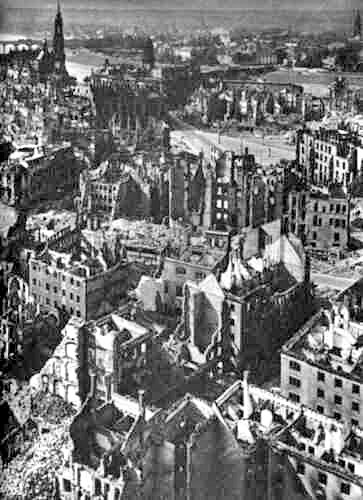
Photo: Aftermath of Dresden Firebombing

Homiletic & Pastoral Review typically has an editorial on the back page written by the long-time conservative editor, Kenneth Baker, S.J. The August/September 2006 issue just arrived with an editorial entitled "A Church in Transition." Fr. Baker summarizes Fr. Claude Barthe's book, Beyond Vatican II: The Church at a New Crossroads:
  1. The Church is seriously wounded (a long list of indicators)
  2. The Church is self-paralyzed and does nothing to heal herself
  3. The Church has replaced a hierarchical government with a democracy--thus becoming a federation of sovereign states, with a weak central government
  4. The Church is now ungovernable and everyone does what he pleases.
Fr. Baker seems to concur with Fr. Barthe's evaluation that the basic problem is the Vatican II document on ecumenism, Unitatis Redintegratio, which led Catholics to believe that sects with their heretical views can be treated as equals. [Incidentally, I find it hard to believe that traditional Catholics haven't added to Wikipedia's description of this Vatican II document.]

Is Barthe correct to claim that there are encouraging signs on the horizon? Yes, I believe the Church under Benedict XVI will:
  • 'disengage' from Vatican II (but it will take a few more years);
  • generate new priests who will attempt to restore the Church;
  • begin the restoration and renewal of the Church with a small set of reforms.
Will the Church recover anytime soon from her wounds? No.

The damage that has been done to the Church and her people is so bad that no man, even a Saint, can restore the Church to health within my remaining lifetime--a maximum of 30 years. Why do I believe this? Because Jesus' parables use nature to teach us truths, and nature is a good illustrator of spiritual dimensions. For example, read Luke 13:6-7 with the parable of the fig tree that did not bear. Also see Kipling's poem, God of the Copybook Headings, about the unforgiveness of nature. God can forgive sins, but nature does not.

Aug 25, 2006

The Wanderer and Church Closings

I've subscribed to The Wanderer newspaper for almost 40 years, even before highly respected Walter Matt (1915-2002) resigned as Editor and formed The Remnant newspaper. At times, I've thought The Wanderer did a great deal of good, especially informing Catholics of their faith; at other times, I wondered if I shouldn't do without them. An example of what I'm talking about can be see in the example May 26, 2006 front page with two articles that seem to be goo-goo-eyed over the appointment of Archbishop Levada of San Francisco as the prefect of the Congregation of the Faith.

The Wanderer's policy is governed by two rules: (1) never criticize the Bishop of Rome, no matter what administrative decision he makes; and (2) criticize the other Bishops all you want (but not quite all of them). The problem with the first rule is that the Pope is not impeccable--he can and will make some mistakes, and recent Popes have made some doozies. The problem with the second rule is that The Wanderer assumes that if they expose a problem, then faithful Catholics will be able to fix it. Wrong, again!

In addition to prayer (always effective), faithful Catholics have three tools to deal with bad Bishops and their bad decisions--only two of which are somewhat effective. Lay Catholics have their voice, their feet, and their pocketbook. After 40 years of using voice and pen, I can vouch for their almost complete INeffectiveness in stopping the bludgeoning of orthodoxy and traditional Catholic practices. First of all, very few Bishops will respond to a problem identified by a layman. Second, try as you may (and in concert with many others) the Pope won't respond--except in a very few instances. Oh, yes, the local Bishop may send back a nice letter--but you'll have a hard time getting most Bishops to effectively respond to serious problems. [Fortunately there are a handful of exceptions in the U.S. and these good Bishops are increasing]

So where does that leave a Catholic who wants to attend a local church not infected by Modernism? He can vote with his feet and attend a Novus Ordo (NO) church that retains a semi-traditional priest who has made compromises to stay an active pastor, but yet promotes a few traditional practices and gives acceptable homilies. Or a Catholic can transfer his membership to a church affiliated with the Society of St. Pius X (SSPX). Some of my friends over the past 40 years went one way and some went the other.

Those who stayed in a NO church came to realize that this solution usually was temporary, so off to another church they went--in some cases, even to a church in another diocese. It wasn't until the indult Latin Mass was allowed in a very few places that a third choice was available. Even then, Catholics who attended the indult Mass were often viewed as temporarily on the fringe of the Church until they could be fully reintegrated into the NO community.

Back to The Wanderer. The new issue of August 24, 2006 has several good articles that make me happy that I've not yet canceled my subscription. First of all is an article (second of three parts) with a lot of irony about "How Anne Burke Surprised the U.S. Bishops." Mrs. Burke is the Illinois Supreme Court Justice who was second-in-command of the Board appointed by the U.S. Bishops to study priestly pedophilia. She assumed leadership when Gov. Keating resigned in disgust. There's a fair amount to disagree with in the article of her interviews by Thomas F. Roeser, but it is an interesting read of why some liberal Bishops seem to wish they had never heard her name.

The second article is on a local subject, "Cloning Measure Would Ax Laws Regulating Abortion." Jennifer Brinker outlines the November 7 ballot initiative on the "Missouri Stem Cell Research and Cures Initiative." She points out that Missouri has several laws dealing with aborted human beings that would be overturned if the Initiative passes.

The third article of interest is about a New Hampshire parish merger and likely church closings. A woman (state legislator) is appealing to the Vatican, asking the Holy See to reverse the merger of three parishes in the Lakes Region and to prevent the closure of a parish. [The lady admits this effort is not likely to succeed.]

Church mergers/closings in New Hampshire are occuring as a result of recommendations from Cluster Task Forces (example here) assembled for long-ranging planning--a process that sounds very similar to the Task Forces being set up in the Kansas archdiocese. Some of the comments of the appellant woman include:
The real reason for the consolidation is to retire the debt.... Once you merge, the money all goes into one pot. There's no reason for this merger other than the money....

...input from the parishioners was given short shrift in the [Task Force] process. They allowed people to come and talk, but they didn't act on any of those suggestions. They didn't listen. Their minds were made up. The whole thing was a farce.

You mean to tell me the mighty Catholic Church can't get a priest to come to St. Agnes (the parish to be closed) for one hour a week?
Finally, another woman supporter noted:
In this town we have an Episcopal church, a Methodist church, and a Baptist church, and none of them have the amount of people going to their churches that we have. But they're not giving up their churches.

Aug 24, 2006

Serious Gardening for Kids

In the summer when I was ten, Mother raised almost two acres of grapes, long rows of black raspberries and strawberries, and other plots of green beans, cucumbers, tomatoes, and other vegetables. My younger siblings and I assisted Mother with gardening, and I was usually allowed a 15-min break after every 15 to 30 minutes of work.

Dad grew up a city boy and worked at construction jobs. He bought a small Farmall tractor from the government after WWII to plow, cultivate, and cut grass and hay. Big jobs were his, such as some barnyard work, building and maintaining fence, using the tractor to plow and cultivate, and installing the posts and wires in the grapes. Mother was responsible for the gardening work which brought income for the family when Dad did not have a job.

My first gardening job in the early spring was to tie the grapes when I came home from Catholic grade school. Mother would have already trimmed the grapes to leave only strong vines for new bunches of grapes to grow, or new lower vines to initiate strong vines for the following year. I occasionally helped her cut old clothes and other waste fabric from feed sacks used to sew new clothes. The waste material was used to make 3/4 to 1" wide by 6 to 10' strips that were used to tie grape vines to three wires strung on posts in each row. It was a matter of intertwining a grape vine through the wires, being very careful not to knock off any buds, and using a strip of material to tie each loose vine as upright as possible to the wires.
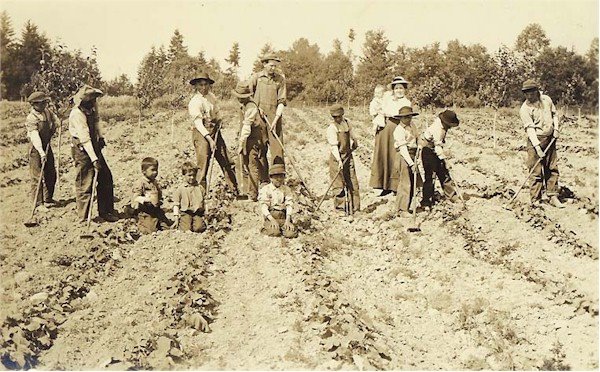
1912 Photo of Boys Hoeing
Hoeing was the most frequent gardening work and it started quite early in the spring. Mother was insistent that weeds were much easier to control if you hoed them when they were small. We learned to use a heavy hoe only when weeds infrequently grew large, such as during a period of constantly rainy weather when hoeing was impossible. Otherwise, an old hoe with a well-worn thin blade was much more productive at cutting the tops of small weeds from the roots. Mother explained that shallow hoeing was preferable to control weeds, with deep hoeing used only when absolutely necessary.

Mother always took a steel file with her to the field to keep our hoes sharpened. Before she used a new hoe and several times afterward, the old hired man of my Grandma would use a hammer and an anvil to pound out the leading edge of the hoe. I remember the loud ring of the hammer on the hoe's cold steel, and I think there is still an anvil in Mother's basement made of an old railroad rail. Only after the hoe's edge was hammered thin would the valuable steel file be used to put a sharp edge on the hoe.

Sharpening a sickle was quite different than sharpening a hoe. The cutting edge of a sickle was used to cut weeds near an obstruction, such as a wall or post. Because a sickle never was supposed to hit anything hard and only cut weeds, its edge was much more important to get absolutely sharp. So a wet stone was used for honing the sharp inside edge of a sickle, rather than the steel file used to sharpen a hoe.

A frost or freeze easily damages strawberry blossoms which was the first crop harvested in the spring (except for rhubarb and asparagus). If frozen, a strawberry blossom develops a black center and no strawberry grows. If Mother said it was going to freeze (and absolute quiet was insisted during the radiio weather forecast), everyone helped cover the strawberries before it got dark. Old quilts, blankets, sofa covers, etc. were used, but newspapers and straw or hay were the primary material used for cover. To keep newspapers from blowing away, a hoe was used to pull dirt around the edges of the newspapers.

Small fragile tomato plants were also protected by newspapers, by making a small hat to cover each plant with a couple of thicknesses of newspaper. In the mid 20th century, the Kansas City Star and Times came twice a day, and they were large, well-read newspapers. If the freeze/frost was not forecast to continue, the cover material was quickly removed the next morning so that the plants could receive warm sunshine.

One year the spring was wet and warm and the strawberries began to easily rot, so Mother recruited all of the family, including Grandma, to help with the picking on an every day basis. Normally, we picked berries every second day--including Sunday. The Church and priests knew that crops were less desirable or could be lost if harvesting was delayed even by a day, so it was considered necessary servile work.

My Dad was home that morning after it had rained the night before and there were a lot of wet strawberries to pick before it became hot. Dad failed to show up in the field and Mother was obviously not happy because the heat combined with the rain would make the strawberries unsuitable for sale. Dad explained that he couldn't stoop to pick berries as easily as his small wife, and he needed to make knee covers so he wouldn't get wet. Mother was clearly frustrated because she was working as fast as she could and it took Dad a long, long time to make those knee covers. He finally showed up in the field with his rubber tire knee covers when Mother and the rest of us were picking the last row. Mother looked at the size of the knee covers and said he would damage the plants with those huge things. I don't remember if Dad picked more than a box of strawberries that day.

I learned that when strawberries and raspberries are picked for sale, the picker carries a 4-legged wooden stand that holds four to six boxes in which to put the berries. The biggest and best berries are saved in one box as another box is filled with the regular run of berries. When the box of smaller berries is almost filled, the saved larger berries are placed on top to make them easier to sell in competition with other growers.

With the berries tat were too small or too ripe, Mother would can as many as 80+ jars of strawberry preserves which she used for breakfast toast, school lunches (strawberry and butter sandwiches were my favorite), and homemade strawberry ice cream. My job was to stem the strawberries so that Mother could cook and can them. I learned to avoid cutting into the strawberry to remove the stem. One time I had to go back to the discarded stems and recut them to remove small pieces of strawberry.

Strawberries are not thorny as are black raspberries, but you can stand while picking raspberries. Standing to pick raspberries is much better than bending over or kneeling in strawberries--take my word for it. When I was ten, we had a very good crop and Mother picked over eight crates of black raspberries in one day. [Each crate held 24 pint boxes.] She was very tired and told me that evening she was so proud of me because I stayed picking to help her. That day, I picked 26 pint boxes of the small berries.

How fast and good a berry picker was my Mother? After I married, I planted a strawberry patch on very good soil where a pig lot had formerly been located. The first crop was of many large berries and Mother came to help me pick. Without telling her, I decided to pick as fast as I could (remember, she was in her mid 50s and I was in my mid 20s) and determine whether I could beat her.

The result was that after I worked as fast as I could to pick two boxes of strawberries, Mother had already picked four boxes and hers were arranged nicer than mine. She explained that when she was quite young, her older siblings made fun of her for picking so slow and called her "slowpoke." Mother told me she was very mad at being called a name and said she practiced picking fast and faster so she could keep up.

Aug 23, 2006

Evangelism in Latin America

The Australian news site MercatorNet is the best Catholic news site I've seen with its excellent commentaries that have previously been recommended by other Catholic bloggers, including Fumare, Amy Welborn, and Curt Jester. One recent news item you don't want to miss is entitled Latin Rapture.

In the MercatorNet article, two Catholic priests in Latin America comment on the huge growth of Protestant Pentecostals in the last 30 years. Some of their very interesting observations:
  • “I believe that if Latin America is still following a Christian path, it is thanks to the evangelicals”
  • n 1900 there were only 25,000 evangelicals in all of Latin America. Now, in Argentina, there are said to be four million Pentecostals and in Brazil 25 million. In Brazil it is claimed that they represent 18 per cent of the population; in Chile 25 per cent; in Colombia 35 per cent; and in Guatemala 45 per cent. (Exact figures are hard to come by.)
  • “Those 16th century Protestants have turned liberal; they accept, for example, abortion and gay marriage,” says Father Julio Elizaga, a Catholic priest who has been working in ecumenism in Uruguay and Latin America for 56 years. “That’s why their churches are empty. The Methodists used to have around 3,500 to 4,000 members in Uruguay. Now there are just 500”
  • “official figures show that in Latin America 11 per cent of the population is evangelical, most of them practising. Pentecostals don’t have two groups of mere believers and practising believers... Some people say that they are Catholic but never go to Mass. This doesn’t happen among the Pentecostals.”
  • How did the Pentecostals seize the initiative? Pastorino argues that Catholics took their eyes off the ball. “In the 1960s part of the Catholic Church followed the ‘progressive’ ideas of the day. Even its language become more sociological; it sidelined mysticism and eschatology,” Pastorino said. It was also a time when, says Father Elizaga, more than 100 priests walked off the job in Uruguay. The door was open for the Pentecostals.
  • However, like most Protestant denominations, Pentecostals are a fractious lot and this hampers their growth in Latin America. “Pentecostal churches are divided; they have neither an authority nor an episcopate. This is their worst problem,” says Father Elizaga. “If they maintained a united front, they would be a devastating force”

Aug 22, 2006

Boston, Creating the Vacuum

Since the late July simulation of priestly ordination of a woman department head in the Boston Archdiocese, I've been perusing the latest news about Boston under Cardinal O'Malley. According to Carol McKinley, a four-year blogger who posts daily items about the devilment going on in Boston, there is little good happening in Boston. Catholic Charities has defended adoptions by homosexuals, priests are leaving for sabbaticals and women, parish collections are falling, people are leaving the active practice of Catholicism, etc.

Financially, the Boston newspaper says the Archdiocese of Boston 'claims' [notice the paper doesn't use the word 'has'] nearly 2 million Catholics in 144 communities. In some ways, the Archdiocese still appears to be rich in a materialistic sense, with over 1,500 buildings in Eastern Massachusetts--estimated replacement value of $2.8 billion. It employs 3,000 people and oversees hundreds of parishes, schools, cemeteries, hospitals, and social service organizations.

While the archdiocese and its parishes have $330 million in assets, officials say financial restrictions and debt total $376 million, resulting in a $46 million gap--a big chunk of change. Despite having laid off dozens of employees, the archdiocese is also running an annual operating deficit, and it faces serious ongoing problems from diminished attendance at Masses, decreased school enrollment, a shortage of priests and nuns, massive maintenance costs for old buildings, etc.

The financial statement from the Archdiocese of Boston shows depletion of assets by selling old church properties. Even though fundraising costs increased 16% from $1.9M to $2.2M in 2005, revenues decreased 6% from $31.6 to $29.6.

Is Boston a bellweather of future diocesan problems through the U.S.? Like California is the bellwether of social problems carried by westerly winds across the rest of the country? Or will prevailing westerlies mostly carry the religious problems of Boston out to sea to drown in the abyss (or maybe carried to Ireland).

Regardless, a vacuum is being created in Boston--of priests, money, Catholicism, etc.--a vacuum that will subsequently be filled one way or another, either with bad or with good.

Aug 21, 2006

Dignitas Connubi (DC) and Annulments

The purpose of the Vatican document, Dignitas Connubii (DC) is designed “to offer the ministers of justice who work in ecclesiastical tribunals a practical Document, a sort of vademecum that will serve as an easy guide to enable them to handle their work better in canonical processes of matrimonial nullity.” When DC was issued in February 2005, it was compared to a similar Instruction, Provida Mater, issued in 1936. The old instruction, Provida Mater, consisted of 240 articles, while the new DC is a somewhat weightier document with 308 articles.

The Code of Canon Law recognizes the following grounds as invalidating a marriage: force or fear; ignorance, error; fraud; intention against fidelity; intention against children; intention against permanence; intention against partnership of life; lack of reason; grave lack of discretion of judgment; and inability to assume the essential rights and duties of matrimony.

So how goes the implementation of DC? Is the new Vatican instruction issued in early 2005 having an effect on annulments in the U.S.? Or is DC like a lot of post-Vatican instructions that have been ignored?

The Canon Law Society of America (CLSA) is a good place to start to see whether DC is being implemented. The annual convention of the CLSA is scheduled for October 9–12, 2006 in Fort Worth (at a $160/night hotel, plus taxes). A pre-convention workshop will be given on Rota Jurisprudence and Formal Marriage Cases. The workshop will explain recent Rotal decisions that impact marriage. Attendees will likely see an expanded list of reasons for nullity of marriages, because the announcement for the workshop says “Other grounds of nullity that have seen development will be presented…”

The 4-day conference program identifies two presentations on marriage. The first one deals with “Negligence, Dolus, and Personal Canonical Liability in Tribunals.” Apparently DC explicitly allows for legal actions for personal damages against tribunal personnel in case of their negligence. The CLSA is clearly concerned about being sued for damages that could be considerable, particularly if they involve reimbursing wedding expenses.

The second presentation considers the bonum coniugum as an essential element of marriage and as a possible exclusion in the processing of a marriage nullity case.

A new book on DC, , Dignitas Connubii: Norms And Commentary, is expected to be released right before the CLSA conference. It sounds like this book will ‘interpret’ DC. After all, how can you apply Canon Law and the 308 articles in DC without a book that explains what DC means? I think this really means that tribunals are struggling with, delaying, or interpretating DC in the most liberal way they can. Don't look for a solution soon to the problem of annulments that sometimes serve as "Catholic divorces."

Aug 20, 2006

Unsettling Statistics on European Religious

My husband believes the annulment flood over the past 40 years should be made a critical topic among Catholic bloggers. Looking around, I found the Feb 8 2005 announcement of a press conference describing Dignitas Connubii that was issued to tighten up 'loose' proceedings in granting annulments, especially in North America. The press conference referenced world-wide annulment statistics from 2002:
It is first of all necessary to provide some statistics concerning causes of matrimonial nullity. The source is the Annuario Statistico della Chiesa for 2002.
The year 2002 seemed a little old so I tried to find a later statistical report.

A search revealed a very interesting Word document simply titled "1" found in the files of chiesacattolica.it. Dated June 1, 2006, the document was edited by Mons. Antonio Ladisa and presents data on religious vocations, especially from Italy as compared to the rest of the world (but none on annulments). Ladisa is studying the vocations crisis in Europe and trying to determine whether the crisis is happening everywhere or only in some locations.

The first table in Ladisa's report presents 1977-1997 figures on the numbers of priests in five regions of the world. Religious vocations in Europe are compared to worldwide numbers. The key statistic is that Europe constitutes 30% of the world-wide Catholic population, but produced (in 1990):
  • approximately 60% of the total of diocesan priests (153,000 of a world-wide total of 261,000);
  • 46% of religious order priests (66,400 of 142,900);
  • 52% of religious (442,000 of 848,000);
  • 43% of the religious brothers;
  • approximately 80% of the members of Secular Institutes
The above data appear disastrous for the future of the church. A very high percentage of world-wide religious vocations in 1990 came from Europe, but Europe now is producing significantly fewer numbers because of a scarcity of children and decreasing Catholic religious practices.

The table below easily shows this very unsettling problem. The number of secular institute priests and nuns from 1990 to 2004 are shown. A world-wide decrease of almost 8% is noted, and almost all of the loss is caused by an 18% drop in European priests and nuns that in 2004 still constituted 72% of the total world-wide members of secular institutes. In other words, large percentage increases in Africa, America, and Asia did not make up for the large loss in European members of secular institutes.

Membri istituti secolari

Continente

anno 1990

anno 2004

variazione

Africa

451

528

17.1

America

4,757

6,043

27.0

ASIA

892

1,527

71.2

EUROPA

25,272

20,800

-17.7

OCEANIA

47

44

-6.4

Mondo

31,419

28,942

-7.9

The document identifies the numbers of 1998 ordinations in each Italian region, notes that foreign priests are needed, and goes into some detail about their characteristics. Almost 1,700 foreign priests serve Catholics in Italy.

One hopeful statistic in the report deals with cloistered nuns in Italy that increased from 5,000 in 1978, to 7,651 in 1998.


Writing the Story for the Boston Vacuum

Carrie Tomko has identified the coming vacuum in the Church as liberal Catholicism ages and dies. Who and what will be poised to enter the vacuum? How can the vacuum be filled with a renewed Catholicism?

The story of filling the vacuum must be written now, as a historian would write from at least 100 years perspective. Some call 'writing the story' a vision or a long-range plan. Whatever it is, you pretend to be a historian, decide what year you want to start, choose the environment, and decide what should happen to achieve a future goal--in this case, restoring the Catholic Church.

Let's start with the Boston Archdiocese, arguably the most notorious un-Catholic environment in the world. With God's help, how could Boston be revived from its dissolution and desolation? Yes, this may be the most difficult environment in which to develop a vision of the future!

What does the Boston Archdiocese have in 2006?
  • Total lack of confidence in the Archdiocese by Catholics who still want to remain faithful to the Church founded by Jesus Christ
  • Bitter memories of the homosexual sex scandals affecting the priesthood
  • Loss of property similar to church confiscations by Communists in foreign countries
  • Terrible demoralization of the priesthood, leading to further losses of existing priests and few candidates for future priests
The only successful story that a historian of 2100 could write for Boston would have to start with a few great saint(s)--preferably the Archbishop himself and a small group of very saintly priest(s) given special responsibility to restore the Catholicity of Boston. Only saints can identify the path Boston really needs to follow and could motivate other priests and laymen to become saints and rebuild the Archdiocese.

Assume the remaining faithful Catholics of the Archdiocese pray fervently to God who answers their prayers by giving them a very few saintly priests and at least 10 saintly laymen--not just good men, but SAINTS. In order to succeed, the Archbishop would have to publicly state that these priests have been given a special charge to rebuild the church in Boston. [An alternative would be to bring in a great traditional order of priests (e.g., FSSP) and give them the responsibility.]

For the first two months, small groups of rotating pastors would be required to attend a special 4-day retreat given by the saintly priests to prepare the pastors and their people for a special Lent of mortification, fasting, and penance. The pastors would be told by the Archbishop that the saintly priests would be given special responsibility for restoring the Catholic Church in Boston.

After the retreats, the saintly priests would travel to key churches in the Archdiocese to say Mass and give sermons--at the prime Sunday Mass times and as the special representative of the Archbishop. On four days every two weeks, each saintly priest would choose a parish in which to give a retreat or mission. And it would be a hard mission that required confession, significant meditation, and sacrifices (not an eat, meet, and retreat conference). The mission would clearly identify the problem with the Boston Archdiocese are SINS of God's chosen people, their own sins and omissions and those of others that allowed the Boston Archdiocese to descend into chaos. The priest would promise the people that if they did sufficient penance their local church would be restored. During a 6-day rest period each month, the saintly priests would be recharged with their own retreat and days of recollection. The Archbishop would listen to their stories and encourage them to continue their important work.

At first there would be a lot of complaints and even further, possibly major losses of priests and money, if I read Boston correctly. The Archbishop, even in the face of initially adverse results, would continue to actively and publically support the saintly priests that he had given his special charge. At the end of a year, the Archbishop would receive a status report from pastors of parishes where the saintly priests had given retreats--to determine the trend in the number of daily communions and weekly confessions--which should definitely increase! However, money receipts during this period might have fallen.

[to be continued in "Boston, Filling the Vacuum"]

Aug 19, 2006

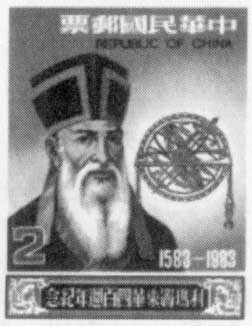
Mateo Ricci--Jesuit Inculturationist

I had thought that Fr. Teilhard de Chardin S.J. had pretty much passed into oblivion, but here comes Fr. Peter Hans Kolvenbach. father general of the Jesuits, who compares Chardin to Fr. Mateo Ricci, who traveled to China and became the court mathematician in Peking. I find the comparison interesting because both of the named Jesuits compromised and adapted their Catholic faith to the environment of the time. Both inculturationists were disciplined by the Church.

Ricci was a Jesuit missioniary of the late 16th and early 17th centuries who spent the last 27 years of his life living and dressing as a Chinese scholar, and is considered a leading inculturationist who incorporated Chinese religious beliefs into Catholic liturgy. Because the practice of ancestor worship was so deepseated in Chinese society, Ricci allowed the new Chinese Catholics to continue with the ceremonies that honored the dead and Confucius. He also used certain Chinese terms to designate God that were later declared incorrect by Popes.

After much controversy and the passionate defense of Ricci by the Jesuits, the accomodations of Fr. Ricci to Chinese paganism were condemned in 1742 by Pope Benedict XIV in the Bull "Ex quo singulari." The Bull required the missionaries to take an oath that such abuses would not be tolerated in the future. Ceremonies in honour of Confucius or dead ancestors and relatives were said to be tainted with superstition to such a degree that they could not be purified.

In July 1983, the Red Chinese published a laudatory piece on Fr. Mateo Ricci. Seizing on this possible opening of Chinese Communism to Christianity, an International Convention to honor Mateo Ricci was held in in Rome during October 2001. The conference was sponsored by the Pontifical Gregorian University and the Italo-Chinese Institute. In a message to participants, Pope John Paul II called for the normalization of diplomatic relations with Red China. He also apologized to the Chinese for errors and actions that the Church in China had committed in the past. Enuff said!

Saintly Service in the Closet

I've been privileged to know a few people who have given saintly service to the Church, yet who will remain mostly unknown in closets of the past. One is a lady who has been dead for over ten years. Her life seemed to be divided into four parts--a very exciting international life before marriage; a happy life with a nice house, couple of kids, and golfing at the country club; a challenging life with a child that brought her into pro-life work, and a more difficult yet serene life when she was mostly homebound because of her health.

My friend was a great letter writer. Many times I would read her commentaries in public and church newspapers and magazines. She was distinctive in that her submittals were often the shortest letters published, yet they usually said the most.

It was her private letters that gave the most saintly service to the Church. She wrote many, many letters of encouragement to good priests who were tempted to leave the priesthood. The priests knew they were being robbed of their dignity and identity in Catholic churches during the 70's, 80's, and early 90's. They felt emasculated by limitations on their authority, certain women given responsibility for priestly duties, and mandatory retreats that left them dry of spiritual life.

From the little my friend would tell me, I knew she corresponded with a goodly number of these priests with her regular letters. Without her encouragement, I believe many good priests would have simply walked away from the horrible messes following Vatican II. Yet these good priests stayed to give the sacraments to faithful Catholics, even though sometimes they were severely limited in what they could and should do.

Esther, May God bless and reward you for your letters of encouragement to priests.

Aug 18, 2006

Large Houses and Lost Sippy Cups


All of our children now have larger houses than we do. Do I envy them? Oh, no! Both my husband and I think a large house is more of a rock around the neck forcing us to spend more money and time than either of us want to give. In addition, a large house requires a lot more effort to clean. I find my own housecleaning a real chore, and I live with the continuing promise of cleaning tomorrow, because I have more important things to do today.

I've just finished babysitting for one of our youngest grandchildren while her parents camped at a nearby lake with the older children. The toddler was good and I had extra time, even to make some brownies. My daughter wants me not to work excessively when I come, so she had gotten her children to help her clean the large house, and it appeared cleaner than mine.

Why is it that I always look for dirt to clean when I go to my children's houses to babysit? It is clearly an unnatural vice, because I always avoid looking at the dirt in my own house. Is it a problem with my eyesight? Or with my focus? Really, I just want to help my children because their large houses often have a lot of variety in cleaning opportunities. And the reward is greater because I usually get hugs and thank you's when my work is done.

The first thing I did after I arrived was to try to find a clean sippy cup so the toddler would not spill her milk. A sippy cup is made of three parts--the cup, the valve, and the lid through which the baby sucks the drink. The sippy cup drawer was full of misaligned parts, and only one lid fit with any of the clean cups, although a couple of correct valves were available. I decided to find some of the missing parts that I knew must be hidden around the large house.

Unless one counts the wastebasket, the most likely place to find missing toys (my grandchildren's greatest sorrow in life) is under things--under the table, under the sofa, under the bed, etc. From experience, I know the most promising place to look for baby bottles and sippy cups is under beds. As I went from bed to bed, I picked up the skirt and peered into the semi-darkness. I immediately found junk, otherwise known as my grandchildren's treasures. Moreover I found dirt--the most evil substance in the universe. [Sorry, League of Evil Traditionalists, you don't come close to matching the REAL thing.]

Success! I found three pieces of sippy cups under the seven beds. I also found an old baby bottle (which the toddler no longer uses) and a complete sippy cup assembly (yes, the milk was curdled into the solid part and the liquid part).

I'm sure my daughter thought her house looked clean enough that I wouldn't look and I wouldn't clean. Old grannies, at least this one, just can't help themselves.

Aug 15, 2006

We Are Hated, Not Evil

"Blessed shall you be when men shall hate you, and when they shall separate you and shall reproach you and cast out your name as evil, for the Son of man's sake." Luke 6:22

Just to get this off my chest...

Aug 14, 2006

Excessive Blogging--A Heresy in the Home

My previous post focused on the mostly sedentary life of a blogger--perhaps leading to a few of us unwilling to show a photo of a fat slob in front of a computer screen. Excessive blogging is actually a heresy in the home that pretends we are only a distant intellectual being and avoids our physical being. The internet doesn't permit a real smile (only an artificial smilie) or hand shaking, and mostly avoids the hearing of our voices.

The danger is especially great if we blog too much with children at home. We may believe that someday our blogs will penetrate to our young children. Yet children are trained in truth by mostly their overhearing external discussions--preferably in person where the child can hear both sides of the conversation.

Our legacy will not be our blogs but our children. I've assigned a scoring system that ranks the different kinds of discussions we have with each other and that can influence our children for good:
  • Old times -- parent to friend in presence of child (2 pts)
  • Recent past--parent to friend on phone (1 pt)
  • Now--parent to others by email and blog (0 pts)
The best training is when a child can hear both sides of an adult conversation (2 points), --provided the parent realizes that part of the conversation that attracts the child is a good teaching experience. In second place (with 1 point) are phone calls with good Catholic pro-life friends. My children say they learned many good things that way, even though they really didn't like Mom to be on the phone so long. Blogging is dead last with zero points because the young child cannot read or is uninterested in reading a non-fiction blog.

Blogging is an extremely effective way of evangelization, in addition to explaining the truth to fellow Catholics and giving and gaining support from each other in times of difficulty. A little alcohol is very good too. But some people seem intoxicated with the web (and I'm finding that it is easy to become addicted).

So just as Alcoholics Anonymous has some questions for a possible alcoholic, here are my questions for bloggers:
  1. Are you searching the web constantly for news items on which to comment?
  2. Are you praying enough that God sends good ideas for your next post?
  3. Is blogging a substitute for cleaning or cooking duties in your house?
  4. Does blogging interfere with your job responsibilities?
  5. Do you spend more than about two hours a day on blogging?
  6. Do you blog during times when your spouse or children are entitled to your help?
  7. Do you believe your blogging will 'save the world'? Where did you get that crazy idea?
  8. Have you recently scanned some secular posts where the vacuous nature of the posts are so apparent? Are you beginning to copy these blogs with your own inconsequential posts?
  9. Is your good health and well-being being jeopardized by becoming sedentary and overweight due to excessive blogging?
So what's the cure for addicted bloggers? Think about it. How many really good posts can you produce a week or a month? I'm surprised that more joint blogs aren't being developed, such as the Shrine of the Holy Whapping. Is this type of blog with several contributors a partial answer to excessive blogging?

Aug 13, 2006

What do Bloggers Look Like?

I've noticed that some bloggers encourage using real names, rather than pen names such as 'dustiam.' I'd like to propose an alternative. Why not use a photo of a blogger or simply post the height and weight of a blogger? We could easily tell if a particular person is showing the effects of too much blogging. [Maybe that's the reason why there are so few pictures of bloggers who are more than 25 years old.]

Based on my experience of less than two months, blogging takes a lot of mental energy but little physical energy. It is so easy to use a nearby flat surface to hold drinks and food that are eaten without thinking. I confess that right now a glass that is within arm's reach was formerly full of milk, ice cream, and chocolate malt. Unfortunately, I told myself it was ok to fix the shake because I exercised earlier.

So here are my questions for bloggers:
  1. Are you now wearing loose fitting clothes or pajamas that have grown a little tighter recently?
  2. Do you prefer to eat your meals and snacks as you blog?
  3. Is the only time you get up from the computer terminal when you go to the refrigerator (or to the littlest room in the house)?
  4. Do you leave your (cell) phone next to the monitor so that if it rings, you don't need to get out of your chair?
  5. If there were a free service for an artist to draw a cartoon of you seated at your terminal, would you post it on your blog? Even if the face were eliminated?
  6. Do you walk regularly by a full length mirror? Do you look and cry?

Aug 12, 2006

Omism, a New Religion

A fellow writer recently read a little of my 'speculative fiction' [The Great Catholic Retreat] and told me that he had never heard of 'Omism'. Omism is my made-up name for a new syncretic religion that I expect to appear and mushroom in the next 100 years.

I think Omism will develop as a light lunch buffet of religious beliefs and practices that combines a variety of different faiths. This new religion will identify itself as containing the best of Protestantism, Catholicism, Taoism, Buddhism, Hinduism, etc.

Well, 'Omism' is here. Actually not yet in the U.S., but in Italy. The Vatican is alarmed about a best-selling book that presents Asian mysticism and spirituality as the keys to life. The author, Tiziano Terzani, argues that people have an “innate moral sense” and do not need institutionalised religion to teach them right and wrong. [Yes, except will the devil argue your case at judgment time?]

One critic said the book was “a confused mixture of Oriental philosophy, Marxism and Christianity” that muddled “St. Francis with Zen Buddhism”. In the past, Pope Benedict XVI has warned of the dangers of trying to reconcile Oriental and New Age spirituality with Catholicism.

Do you know how I picture Omism? As a twisting black smoke snake that my kids used to light on the ground at Fourth of July.

Aug 11, 2006

The "Guide" of Religions in China

A search for 'Catholic' on the official China news website brings up a recent interview with Ye Xiaowen, director of the State Administration of Religious Affairs. The interview represents Ye's first open remarks since he took office ten years ago. [He never once mentions God in the interview.]

Ye claims his country has "more than 100 million faith followers," and he wants them to focus on peace, non-violence, and environmental protection. Thus he denies that religion's primary purpose is the spiritual welfare of men--to assist them to live a good life and die well. Of course, Communists don't believe men have eternal souls that are accountable to God, do they?

I am sure that the Pope looks at the possibilities for China to be a great country if that large and increasingly powerful nation were to believe in the true God and renounce atheistic materialism that leads them to a hell on earth--no matter how rich they become.

Listen to Ye as he insists China must "guide" religions.
First of all, the government will guide the religions to try to explain their tenets in ways that are in line with the requirements of the development of the society. Other religions are also facing the need of fresh explanation of their tenets to keep pace with the social development
The old Communist Chinese government really believes it is capable of explaining the tenets of Catholicism! What a cow! Clearly, the only hope of Christians in China is for the old communist, Ye, to be replaced by a more perceptive individual who understands the good that faithful Christians have accomplished in other societies of the past and the immense good that Catholic teaching can do for China in the future.

The Joy of My Youth

Creeks, Crawdads, Critters, and Concrete

The first prayer of the old Latin Mass is from David's Psalm 43: 4-5 and contains the phrase, "to God the joy of my youth." This prayer recognizes the joyous encounter of King David as a child with God. This post tries to understand why David had such a joyful childhood, and how his happy childhood might be imitated today.

Almost everyone knows David was annointed King of Israel by Samuel, killed the Philistine giant Goliath with a slingshot, and was the most famous Israelite King in history. Yet there is no history of his early life tending the sheep while his brothers followed King Saul. What is the life of a young shepherd when he later refers to "God, the joy of my youth"?

In the Middle East, rocks are used to construct fence walls and enclosures for animals. With the help of his dog, David probably penned his small flock of sheep in one of these enclosures at night. Even while sleeping next to his dog, he would have sensed problems with the sheep (they are good at baa-ing if they sense trouble).

David would have been delighted at the birth of new young lambs, and their finding their mothers to nurse for the first time. Perhaps he would have coaxed a ewe who had a stillborn lamb to accept one of triplet lambs.

At night, David would feel a chilly wind and wrap himself more tightly in his wool blanket. He would have heard the many natural sounds of night, and would have been transfixed at meteors darting across the random array of stars. There would have been a silence in the countryside that was not present in his village.

In the early morning, the dog would have arisen at the sound of awakening sheep. David would have quickly packed his food and water for the trek. Then he would enter the pen, count his sheep, and made sure that all of them were able to move to the graze. After the sheep would have been let out of the pen, David and his dog would have kept them moving to the graze. The early morning temperature would have been cool, but the fast walking would have warmed the young shepherd. On the way, the sheep would stop at a creek for water, and David and his dog would have drunk too.

If a ram were around, David would keep a close eye on him because of having bruises from being butted hard in the past. The young shepherd would have a wood stick with a hook on the end of it--to use in walking, to protect himself from rams, and to capture sheep by hooking their rear leg. David would have looked often at the well-worn crook that had been passed down to him when his grandfather died.

A new grazing area would have been at some distance from the protected holding pen, and the sheep were always extra hungry when reaching their graze. During the time when they were unsettled, David and his dog would have worked hard to keep the sheep from wandering off to nearby trees and shrubs. Before too long, the sheep would have recognized the boundaries of their graze, because the dog would nip and bark when the sheep started to move outside the designated area.

David's flock would have settled into a pattern of moving across their graze. The grazing pattern

usually takes the shape of a fan with the flock's dominant sheep at the apex of the curve. The sheep methodically "mow" the grass as they move across the meadow. They maintain the fan shape most often when they are eating grass that is uniformly shorter than about six inches. If the sheep are grazing sparse patches of grass, a stubble field, lush tall grass or a planting of diverse species, the flock will not graze in a unified pattern. Instead, each member of the flock will be looking for the biggest bite of sparse or tall grass, and in the case of a diverse planting, each sheep will be searching for his favorite morsel.

David observes the sheep grazing contentedly for a while and he sits on a rock to eat a late-morning meal. The dog joins him and lays down at David's feet to eat small pieces that he knows will drop from David's bread, cheese, and meat. When the sheep begin to approach forbidden or dangerous areas, David arises from the rock to work with his dog to bring the sheep back to the intended grazing area. The sun is bright, the grass is green, and the world looks very good to David. Or it is cloudy and he suffers through a damp, chilly day to look forward to the good weather he knows he will probably have tomorrow.

In the late afternoon, the sheep are herded the long way back to the holding pen. David and his flock stop at a small stream so that the sheep can drink. While the sheep are drinking, David picks up stones and sticks to toss in the water, or if the water is wide, he throws stones from his sling, making them skip across the water. He found life in the water--snails, frogs, water spiders, crayfish, or small minnows. He kept one eye on the sheep, but I suspect David stayed at the stream to play for as long as he dared.

When David arrived with his sheep at the holding pen, he would have looked each one over carefully before penning them. As he touched the sheep, his hands would have absorbed some of the lanolin in the wool. [A sheepherder's hands are never rough.) His mother, or one of his father's servants, would have brought him food for the evening and the next day. They would have exchanged details of the day's events. Other boys would have arrived and David would have shown them the special rock or toad he had found. They would have discussed the children in the next village who recently saw a wolf.

A joyful youth such as David experienced is what we want to give our children. I experienced such a joyful childhood because of the creek and animals on my Grandma's and our adjacent farms.

There is a great joy playing in the creek and lifting a rock and finding a crawdad. If you're fast enough, you can grab him behind the pincers and put him in an old bucket. Maybe you can build a dam of rocks to hold a little pool of water. If you catch a minnow with a butterfly net, you can put it in the little pool, but he'll probably find a way out. Or you can take a cold drink from the pipe coming out from the deep, spring-fed well by the creek. Or you can look at the puffy clouds and make believe you see a horse, a bird, or a snowman.

Some of my grandchildren are blessed to live on some acreage adjacent to a creek, and their mother tells me they play all day without being bored. Water in the creek flows over a concrete abutment, and the creek is slightly deeper there. Frogs, minnows, crawdads and some water snakes are easily found.

Once I went to Home Depot or Lowe's and bought an 80-pound bag of concrete mix. One of the grandkids got the wheelbarrow to take some of the concrete mix down near the creek. We took a gallon plastic milk jug, cut out the top, but left the handle. The kids put some water in it and added some concrete mix. They stirred it with a stick, then dumped succesive jugs of the wet mix in the creek to form a dam. Best $3.75 I ever spent on a toy! [BTW, the grandkids were told that they had to wash their hands in the creek whenever they got concrete on them.]

The Natural Wildlife Federation [not necessarily recommended for all their positions] has an interesting article excerpted from the book, Last Child in the Woods: Saving Our Children from Nature-Deficit Disorder. The author observes:

A child today can likely tell you about the Amazon rain forest but not about the last time he or she explored the woods in solitude or lay in a field listening to the wind and watching the clouds move. Parents cite several everyday reasons why their children spend less time in nature than they did. Among them: diminishing access to natural areas, competition with electronic entertainment, and time pressures, including increased homework and longer school hours.
I believe people have joyful childhoods when they grow up in the outdoors and experience natural flowing water such as creeks. They also learn responsibility when they must take care of animals, like young David did. Do what you can to bless your children with a childhood that makes them acknowledge "God, the joy of my youth."

Aug 10, 2006

Pictures/Cartoons of Priestesses

The Chamberlain Family seems to be a geneological website that has some interesting pictures and a cartoon of the newly ordained priestesses. The 'Catholic' priestesses are put into the context of priestesses ordained in the Anglican, Episcopal, and Presbyterian churches.

Focus on the Past and the Future

Most bloggers scan the web for the latest news on keywords 'church,' 'religion,' 'nun,' 'vatican,' etc. However, this blog prefers to focus on the past and the future. That's why you will read more stories about people in the past who lived for better or worse, together with their legacies. Here are some of these posts.
You'll also read about things that happened a long time ago.
Finally, you'll read a little bit of science-fiction that is being updated on a periodic basis. What is happening today happened because of something else that happened in the past. Your comments and constructive criticisms on these future projections will be appreciated.

Aug 9, 2006

A 1959 Image of the Modern Church

Li Wei-han was a leader in the Chinese Communist Party from its foundation in 1921. From 1944 until his eclipse in December 1964, he was Director of the Party’s United Front Work Department.

Li Wei-han wrote THE CATHOLIC CHURCH AND CUBA: A PROGRAM OF ACTION for the new Communist Party in Cuba formed by Fidel Castro. The document was published in Spanish by the Foreign Languages Press of Peking for the Latin-American Section of the Liaison Department of the Chinese Communist Party. Many years ago, the Vatican newspaper, L'Osservatore Romano, published this plan and reported it had been used against the Catholic Church in China, Czechoslovakia, Romania, Poland and Cuba.

The secret plan to take over the Catholic Church in Cuba was issued in 1959--several years BEFORE Vatican II. In hindsight, the Church following Vatican II seems to have implemented the Red Chinese plan with the disastrous results that we see today.

One Chinese recommendation was to set up a Bureau of religion in Cuba to impose "the procedure of 'democratic centralization' on the Church." Some might say the the National Conference of Catholic Bishops is similar to the religious Bureau recommended by Li Wei-Han.

Another selection from the Chinese document refers to using special laws against Catholics
who protest. They must be thought as unpatriotic criminals obeying the imperialistic instructions emanating from the headquarters of the Catholic Church, the Vatican.
Are traditionalist Catholics who protest against wayward churchmen and activities targeted for discipline, while heretics and apostates escape punishment for their misdeeds?

The document says that occasionally a "two steps forward, one step backward" approach must be taken when people are psychologically torn between the Church and the government. Some would say this tactic also has been used whenever Catholics become too uncomfortable with liberal changes in the Church.
When the People's Government is performing the 'one step backward,' it must proclaim that it is .... in deference to the wishes of the masses that it is setting up Committees of reform in the associations, so that the patriotic masses can express their views more directly in the running of Church affairs.
The above paragraph, if slightly modified, could easily refer to the many committees that have been enrolled in the management of Church structures since Vatican II.

A further quote,
It is important that the ecclesiastical authorities and the Bishops should assure the masses that religion has become purer as a result of being liberated from criminal and unpatriotic elements.
There are a number of ecclesiastical authorities who have proclaimed the Catholic religion is more pure because of being liberated from unreasonable and old-fashioned Church laws of the past.

Does the following paragraph remind you of words that assure Catholics that they can coexist with the modern sinful world?
The task of our militants is to convince the masses that individuals can have their own religion without the Vatican having the right to dictate in the affirms of all the Churches in the world. Our militants must also explain the principle of the coexistence of patriotism and religion. In this way the masses are alienated from those who take their cue from the Vatican, and the way is opened for the establishment of an independent Church.
...we must accumulate all the arguments necessary to convince the Catholic intellectuals that a break with the Vatican is a step forward and not a step backward. ...The masses are but tenuously linked to the Vatican in their religious practices.
The most important paragraph of Li Wei-Han's document that describes tactics to destroy the Catholic Church in Cuba relates to making optional the practices that were formerly considered mandatory for a good Catholic.
Once the time comes when the posts of responsibility in ecclesiastical affairs are in our hands, and their incumbents are docile to the will of the People's Government, we shall proceed to the progressive elimination of those elements of the liturgy which are incompatible with the People's Government. The first changes will affect the sacraments and the prayers. Thereafter the masses will be protected against any pressure or obligation to attend Church services, or practice their religion, or organize societies with some devotional purpose. It is notorious that when the practice of religion becomes simply a matter left to the individual's sense of responsibility, it is gradually forgotten. The rising generations will succeed the older, and the religion will become merely an episode of the past, important only as a topic to be considered in histories of the world Communist movement.

Ask yourself whether the changes since Vatican II did not almost totally eliminate the sacrifices required on Fridays and during Lent and Advent, many devotions and reverential practices, the number of Holy Days, the need for Confession before Communion, etc.

Aug 8, 2006

Why We Are Fighting Culture Wars

In a 45-year period starting in 1955, a woman whose pen name was Ann Landers wrote tens of thousands of words of personal guidance for her readers in most of the major newspaper in the U.S. When she died in 2002, her press syndicate said:
When Eppie Lederer took over the Ann Landers column in 1955, no one, including her, realized the tremendous impact she would have on all of us. Ann Landers was someone people could confide in, when they had nowhere else to turn....And she changed newspapers forever, becoming an intrinsic part of the American culture: Everyone knows Ann Landers.
Yes, Eppie Lederer changed American culture and that's why we now have culture wars. I remember a time in the 60s and 70s when the first thing that everyone read when they opened the paper was the Ann Landers column. A 1978 World Almanac poll found that Lederer was "The Most Influential Woman in the United States." Her popularity continued through 1997 when 90 million readers of 1,200 newspapers were said to "take Lederer's counsel like a tonic."

Her day-to-day advice is what caused this nation to accept homosexuality, divorce, and abortion. Did 'Ann Landers' start out that way? Heavens, No! Most of her early columns could have been written by my Grandmother or a Catholic priest. But once she was accepted as the nation's godmother or councilor, her advice began to change.

In a 1997 interview, 'Ann Landers' said she once
accepted the early '60s definition of the American Psychiatric Association, that homosexuality was a deviant psychiatric disorder. She now believes authorities who say one is born with this orientation. Regardless of the cause, she is not judgmental and has always urged tolerance.
'Landers' also convinced her readers of the ten percent myth: "According to some studies, an estimated 10 percent of individuals worldwide are homosexual."

Same thing with divorce, according to the interview.
Forty years ago her position was this: "You made a deal, stay with it thick or thin." And if the woman was in an abusive marriage: "Go to your clergyman, go to your doctor, work it out, work it out, work it out." Since then, because of her own divorce, the changing times, and public opinion, Lederer has broadened her acceptance of divorce. While brutality, alcoholism or infidelity certainly warrant divorce, she now also includes marital unhappiness or dissatisfaction: "Some people just don't belong together and it's too bad if they think they have to spend the rest of their lives together when it's not working."
What did 'Ann Landers' teach about abortion? The Jewish Virtual Library notes
While in the 1950s she encouraged women to stay at home and to accept, if necessary, their husbands' infidelities, by the 1970s she was urging women to find worthwhile occupations and was a champion of liberalized abortion laws.
Did 'Ann Landers' intend to change the world? She once said "I select letters [for the column] that give me an opportunity to teach people something. This was my mission from the beginning."

The Adoption That Never Was

Loretta Young (1913-2000) was a movie star who made nearly 100 movies from 1927 through 1953. She hosted the very popular Loretta Young Show on TV beginning in 1953, and the series continued through 1961. She played the lead in 162 episodes of this drama anthology series. The Loretta Young Shows could be mostly relied on to emphasize faith and moral values.

Loretta Young was known for her religious faith and work on behalf of Catholic charities. Her scripts contained stories about family, community, and personal conviction, leading to the resolution of moral challenges. Every episode was summed up with a quotation from the Bible or some other recognized source. Her work was honored by numerous civic and religious groups. She was the first woman to win both an Academy Award and an Emmy Award.

I knew Loretta Young was a Catholic (but I'm not sure I knew she was divorced) when I looked forward to her TV shows in the 50s. She was well-known for being one of the two energetic nuns in the hit movie of 1949, Come to the Stable. After the end of her TV series, she retired but returned in 1986 to earn a Golden Globe Award for her performance in a made-for-TV movie, Christmas Eve, that was far above the secular movies of the time. Her last appearance was in another TV movie in 1990. She continued to be active in Catholic charities until she died in 2000 at the age of 87. Her TV shows are now being run on Sky Angel and are sold by Amazon.com.

Now, for the rest of the story.

Loretta Young was already a very successful young actress when she made a hit movie in 1935 with Clark Gable as her co-star. She was attracted to his famous masculine image. What happened next was that Loretta became pregnant by a married man not her husband.

She did what many Catholic girls did at that time, she hid her pregnancy to avoid the scandal and to prevent cancellation of her studio contract which prohibited immoral behavior. In those days, unmarried pregnant girls who did not marry the father of their child usually went to another town 'on vacation' or to 'visit an aunt' (Loretta and her mother went to Europe). Then the baby of the unwed mother was usually given up for adoption. In many instances, the girl returned home with no one the wiser.

Loretta Young decided to keep her new baby girl, a rarity in that age. But how? She announced that she was planning to adopt a baby that needed a home. In the terrible depression of the mid 1930s, Loretta's action was viewed as admirable. So Loretta's baby was "adopted," received the name of Judy, and lived with Loretta Young. After Loretta was married in 1940 to Thomas Lewis, the little girl took the name of Judy Lewis. Loretta's daughter continued to be told she was adopted as she grew. But she inherited her famous Dad's ears and these were surgically altered.

According to Judy's autobiography, she first heard that Clark Gable was her father from other children at school. But only after her first child was born did Judy Lewis definitely learn there was no adoption and that Loretta Young was her birth mother and that Clark Gable was her father.

Loretta Young committed a number of public sins during her lifetime, including divorce and remarriage, affairs with married men, and wearing low-cut dresses. Yet in an interview with Palm Springs Life magazine about four years before she died, she said Ingrid Bergman once asked her
"Do you really believe that there is anything after this life?" And I said, "Oh, I'll say. That's why to me every single solitary moment is so important. What I do here is going to decide whether I go to heaven or hell. And when I was 16 I decided I was not going to go to hell. And you can decide that. You may boo-boo 10 times a day. That's why we have confession. As long as you're sincere and trying to break the habits." Well we had a heartfelt discussion and I said I was preparing for the afterlife every day.
Marlene Dietrich, not the kind of famous actress a Catholic would like to imitate, nevertheless gave Loretta Young a remarkable compliment that I'll always remember, "Every time she 'sins,' she builds a church. That's why there are so many Catholic churches in Hollywood."


Aug 7, 2006

Two Types of Family Farms

Some traditionalist Catholic bloggers want to remove themselves from the city to an agrarian life, including Fr. Lawrence Smith who was interviewed recently by Stephen L.M. Heiner. Fr. Smith has chosen to live near a very small community in Wisconsin because he believes city life is not conducive to Catholicism and:
The medieval economic model was wedded to the Faith. The modern economical model attacks the Faith.
The forced migration of the entire earth to cities is the destruction of freedom; it is the corralling of people so that they are wholly dependent on Big Brother – this attacks both the family and the Church. This means the powers that be can starve you to death if they please. The fear of being starved to death allows the powers that be to coerce the obedience of those thus enslaved.
I believe that an agricultural life might be feasible for families in the 21st century, but it likely to take some very modern things to accomplish it. Let's start with describing how a self-sufficient farm operated about 75 years ago.

A Small Family Farm in the 1930s

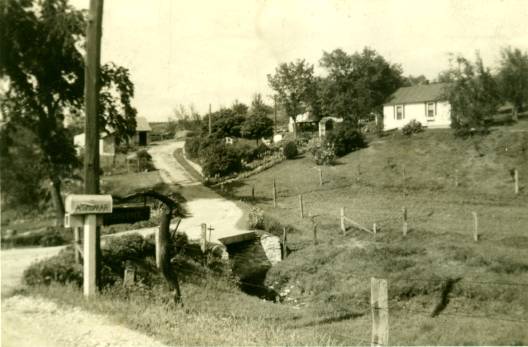
My Grandma had a approximate 20-acre truck farm (couple of cows, a horse, chickens, pigs, berries, grapes, fruit trees, vegetables, alfalfa) located across the road and creek from where I grew up as a child. She earned her entire income from this farm.

The hired man used a horse to prepare the ground for planting and to cultivate between the close rows of berries and vegetables. The manure was stored in piles and later carried to the field on a sled for distribution as fertlizer.

Grandma never had water piped inside her small house. The outhouse was about fifty feet from her front porch on which we sat, talked, and shelled lima beans during hot summer evenings. Indoor recreation consisted of talking among family members and visitors, and playing games and cards. Outdoor recreation consisted of horseshoes, walking, raising goldfish, playing in the creek and catching crawdads, and shared meals and conversation with relatives and friends who visited.

Her always cool water for drinking, cooking, cleaning, and bathing came from either a cistern or by walking from the house down to a spring-fed well at the bottom of the hill and then carrying the buckets back up the hill to the house. A creek was close to the west edge of her property, along the county road.

Grandma had no basement, just a cellar dug in the dirt under the house. A couple of casks of home-made wine and jars of preserved fruits and vegetables could be found in the cool cellar. In the fall and winter, a crock was filled with shredded cabbage to ferment into sauerkraut. A truck with many cross-slats to hold crates of berries, vegetables, and fruits was used to transport produce to the City Market about every two or three days during picking seasons.

The barn was used to store farm tools, provide shelter for the horse and cows, and allow hay to be kept protected in the loft. A small white chicken house was located close to the outhouse and further away from the hired man's one-room house. A pig shed completed the buildings on Grandma's farm.

Grandma's farm was mostly self-sufficient during the depression of the 1930s and during the rationing of essential items during World War II. They still needed to buy gasoline and tires for the truck to take produce to the City Market, electricity for lights and the cook stove, coffee, sugar for canning, clothes and shoes, and a few other things. But they had food, water, and a warm house with a wood stove. Grandma told me she could make bleach from wood ashes and also make soap from the lard of her pigs if she had to, but she usually bought these items. She was assisted in farming by a hired man and my Mother. During picking season, poor people were hired and paid by the box.

The major uncertainly was the weather. One spring the crops were planted and a freeze in mid to late May destroyed all the young plants. Everything had to be replanted and my Mother remembers that they produced very good crops for the rest of the summer.

Rainfall was problematic and I remember my Grandma and Mother (who helped Grandma with farming) praying many times for rain during periods of drought. Only the vegetables planted near the creek could be fairly easily watered during dry spells.

Children either went to a Catholic school or a much closer public school.

Small Family Farms in the Early 21st Century


Several Catholic families, each with a number of children, live west of Kansas City on acreage that ranges from several acres to about twenty acres. Taken as a whole, here are some of the elements that distinguish a small family farm in the 21st Century.
  1. The fathers all work at salaried or self-employed jobs with benefits (either paid for by self or by an employer). Most parents are well-educated.
  2. The family saved up sufficient money to buy land and a typically large house in the early years of marriage
  3. All the farms have barns; some shelter horses, cows, goats, and lambs, and store hay
  4. Farming is on a significantly smaller scale because mass production of animals and eggs means these products are often bought more cheaply than if they were raised
  5. The great majority of family food is bought, rather than raised, especially during non-harvest seasons and when fresh and frozen products are desired
  6. At least one family has a chicken house and raises chickens and eggs, although the reason for the chickens is simply to teach the children to work and be responsible
  7. Horse manure is picked up from the pasture and barn and used for garden fertilizer
  8. Homes are plumbed with water and waste systems (septic tanks)
  9. None of the houses have installed cisterns to trap and store water from rainfall on the roof
  10. Water is obtained from rural water systems
  11. New houses are well-insulated and heated using high-efficiency wood fireplaces and propane furnaces
  12. Houses have refrigerators and freezers to store food
  13. Air conditioners are used during hot periods
  14. Inside recreation consists of CD and DVD players and electronic games
  15. Cooking stoves are propane or electric
  16. Horses are not used as draft animals but for recreation
  17. Gasoline powered tools are the norm, including lawn tractors
  18. Gasoline and propane are often purchased in quantity and stored on the farm
  19. A limited number of berries, vegetables, and fruits are raised for home consumption but are not sold for money
  20. Trees and plants are irrigated during droughts
  21. Garage sales and Ebay are patronized for clothes, shoes, house items, toys, etc.
  22. Families often share children's clothes and expensive equipment with each other
  23. Labor for the farm is supplied, not by hired hands, but by parents and their children.
  24. Outdoor family recreation on the farm includes playing in creeks and barns, catching crawdads and minnows, riding horses and 4-wheelers, swimming in large plastic pools, jumping on trampolines, and shooting BB guns and arrows
  25. One family has installed wind turbines and solar cells to generate electricity that is stored in over a ton of lead acid batteries; In most periods, this family is able to provide electricity for all their home needs
  26. Children are almost all home-schooled.
Similarities between the family farm of the 1930s and a small family farm of today are somewhat apparent, but there are significant differences. Can we ever return to the early part of the last century with its agrarian economy? I don't think it is possible. However, the family farm of today provides many opportunities for channeling the energy of children into productive work and responsibility for animals. It also has the potential for being a lot more self-sufficient in case of depression or wartime shortages. Moreover, children living on a farm are never bored; they have a much larger area in which to play and more things to investigate, especially if animals are present and a creek is available.

Argent and the Poncho Ladies

Argent has posted news of one of the new priestesses who simulated a Catholic Mass in the Philadelphia area. The woman is really a high school nurse who is "an active member of the Church of the Beatitudes, a congregation of about 20 people in the Old Catholic community. The group rents space from Garden United Methodist Church in Lansdowne."

What I really like most about Argent's post is his name for the priestesses--Poncho Ladies.TM