Sep 2, 2006

Onward, Christian Soldiers!

My dad was a convert to Catholicism back in the 1930s who loved the song, Onward, Christian Soldiers! He taught it to us and we kids would march around the house singing this Protestant song, much to the dismay of my very Catholic mother. Actually, the words of the song did not offend against Catholicism, so mother held her peace.

Onward, Christian Soldiers! seems to exemplify militant Catholicism to which we are called by the sacrament of Confirmation. As defined in the Catholic Encyclopedia and Baltimore Catechism, Confirmation is a sacrament in which the Holy Ghost is given to those who are already baptized in order to make them strong and perfect Christians and soldiers of Jesus Christ.

In Scripture, several references refer to being a good soldier for Christ. For example Paul says to:
11 Put you on the armour of God, that you may be able to stand against the deceits of the devil. 12 For our wrestling is not against flesh and blood; but against principalities and power, against the rulers of the world of this darkness, against the spirits of wickedness in the high places. 13 Therefore take unto you the armour of God, that you may be able to resist in the evil day, and to stand in all things perfect...16 In all things taking the shield of faith, wherewith you may be able to extinguish all the fiery darts of the most wicked one. 17 And take unto you the helmet of salvation, and the sword of the Spirit (which is the word of God). (Ephesians 6)

Labour as a good soldier of Christ Jesus. (Timothy II 2:3)

I have fought a good fight, I have finished my course, I have kept the faith. (Timothy II 4:7)
Fr. John Hardon, S.J., repeats the traditional definition of the Communion of Saints as consisting of three levels:
the Church Militant on earth, the Church Suffering in purgatory, and the Church Triumphant in heaven. After the last day, there will be only the Church Triumphant in heavenly glory.
However, the new Catholic Catechism issued in 1992 obscures the definition of the Communion of Saints by referring to those alive in this world as "pilgrims on earth." No. 962 states
We believe in the communion of all the faithful of Christ, those who are pilgrims on earth, the dead who are being purified, and the blessed in heaven, all together forming one Church; and we believe that in this communion, the merciful love of God and his saints is always [attentive] to our prayers" (Paul VI, CPG § 30).
Onward, Christian Soldiers! was published in 1865 by the Anglican clergyman and prolific writer, Sabine Baring-Gould, who prepared it for a group of schoolchildren who were to march to the next village. Baring-Gould is thought to be the man who inspired Pygmalion, a story later made into My Fair Lady. He fell in love with a simple mill girl and sent her away to be educated for two years before he married her. The couple were married for 48 years and had 15 children.

Here are the words to Onward, Christian Soldiers:

Onward, Christian soldiers, marching as to war,
With the cross of Jesus going on before.
Christ, the royal Master, leads against the foe;
Forward into battle see His banners go!

Refrain
Onward, Christian soldiers, marching as to war,
With the cross of Jesus going on before.

At the sign of triumph Satan’s host doth flee;
On then, Christian soldiers, on to victory!
Hell’s foundations quiver at the shout of praise;
Brothers lift your voices, loud your anthems raise.

Refrain

Like a mighty army moves the church of God;
Brothers, we are treading where the saints have trod.
We are not divided, all one body we,
One in hope and doctrine, one in charity.

Refrain

What the saints established that I hold for true.
What the saints believèd, that I believe too.
Long as earth endureth, men the faith will hold,
Kingdoms, nations, empires, in destruction rolled.

Refrain

Crowns and thrones may perish, kingdoms rise and wane,
But the church of Jesus constant will remain.
Gates of hell can never gainst that church prevail;
We have Christ’s own promise, and that cannot fail.

Refrain

Onward then, ye people, join our happy throng,
Blend with ours your voices in the triumph song.
Glory, laud and honor unto Christ the King,
This through countless ages men and angels sing.

Refrain

Internet Pornography in the Schools

Mrs. M, my friend in the 'nut-house' (that what she calls her nursing home!), called a few minutes ago to tell me about an extended discussion she had with the room janitor. They discussed whether pornography could be accessed by students on public school computers, and the young man said, "yes." She then called a friend who said that internet pornography at public schools was not filtered. Moreover, a substitute teacher in a nearby public school was found to have pornography on his school computer and nothing was done.

Mrs. M. is going to call the public school office on Tuesday morning and also will call the local TV stations. She's brave and determined--and I wish people who were healthy were determined to do as much as Mrs. M does from a shared phone in nursing home.

You see, Mrs. M has a son who is in prison for a long time because he plead guilty to pedophilia. She knows when he comes out, he will be forever labeled a child molester and people won't want to live near him. Mrs. M believes her son's downfall was pornography.

Sep 1, 2006

The Last Steps of a Ladder to Heaven

Tomorrow is the First Saturday of September and we will honor the Blessed Virgin Mary. My Grandma had a special love of Mary and would say five rosaries each day until the day she died (almost 100 years after she was born). When things would go wrong, I always heard her exclaim, "Mary, Help me!" (in her native European language).

One time Grandma told me this story of an intense dream she had when she was young. In her dream, she was climbing a ladder to heaven. Others were climbing their own ladders--some with more strength than others, and some were falling to the ground only to begin again.

The climbing was very hard, especially as Grandma reached higher and higher in the sky. Several times, she had to stop because she had no strength to continue, but then she would resume climbing again. Finally, she could see heaven and God waiting for her, but as she climbed closer, her strength totally gave out. Not only was she unable to take another step upward, she felt her grip on the ladder slipping.

As she realized all of her prior efforts to climb to heaven were going to be for nought, suddenly a hand reached down and gently pulled her the rest of the way into heaven. She looked up and saw the face of Mary, the Mother of God.

Aug 31, 2006

Catholic Military Personnel -- New Data

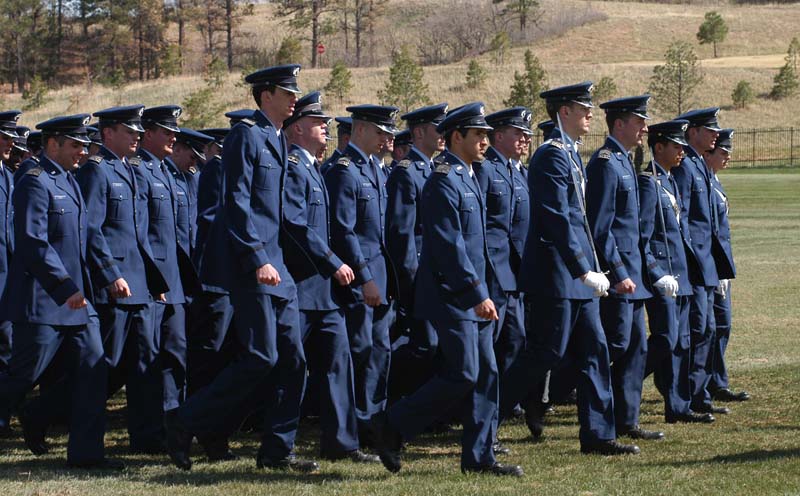
Two young grandsons visited the Air Force Academy in Colorado Springs this summer and were very, very impressed with the marching cadets and drums. The parachuting exhibition also helped to inspire them to ask how old they have to be to enter the Academy. Their parents answered '18' and said that they needed very good grades to be selected.

Since the boys' question, I've been curious about the percentage of Catholics in active military service. The recruiting site for Catholic chaplains states that:
40% of those in the Navy, 28% in the Air Force, and 25% in the Army are Catholic, currently, there are a little more than 140 priests in the Navy, 90 in the Air Force, and 105 in the Army.
The active military force is 1.4 million, including 366 thousand in the Navy, 178 thousand in the Marines, 359 thousand in the Air Force, and 512 thousand in the Army. If 40% of the Navy and Marines are Catholic, then there are 218 thousand Catholic sailors and Marines for 140 priests--approximately one priest for every 1,550 active duty personnel. If 28% of the Air Force is Catholic, then there are 101 thousand active duty military for 90 chaplains--approximately one priest for every 1,120 active duty military. If 25% of the 512 thousand Army members are Catholic, then there are 128 thousand Catholic soldiers for 105 chaplains--approximately 1,220 soldiers for each chaplain.

From the calculations above, the total number of Catholics in the active Armed Forces of the U.S. is approximately 447 thousand out of 1.4 million--32 percent. How does this figure compare with the percentage of Catholics in the U.S.? Adherents.com, which specializes in statistical data on religions in the world, says the U.S. has 61 million baptized Catholics for 26% of the population. Obviously, if the military services of the U.S. are composed of 32% Catholics, then Catholic military personnel are contributing more than their fair share--especially in the Navy and Marines.

[It should be noted that military chaplains serve more than just the active military force described above. Catholic chaplains are stated to serve a total of
1.4 million Catholics, including spouses and other family members, and other personnel.]

Aug 30, 2006

Actions in a Crisis--United Flight 93

I've often been fascinated by stories of people who exceed what is normal. Sometimes, a person wants to meet the high expectations of others and performs exceptionally well. Alternatively, excessively high expectations may lead a person to say, "What's the use" and fail to try. The most interesting situation is when persons perform great feats of bravery, strength, or endurance in a challenging crisis.
A very long time ago as a seven-year old, I used to walk over a mile home from Catholic grade school. The road led up and down over the hilly terrain above the Missouri River, finally ending up by a roadside creek. One afternoon, I decided to leave the road and take a short cut across our pasture. Bad choice! The milk cow that we had at time was not friendly. Once she saw me, she charged and I ran toward a fence on the upper edge of a deep ditch along the road. The ditch was filled with weeds and debris, and that was where I landed after jumping the fence.
Later when the cow was elsewhere, I went back to the fence to see how high it was. Amazingly, the top of the barb wire fence was above my waist. I remember setting up a rope to practice jumping the same height--and at that age I couldn't do it again. Conclusion: I could do very difficult things only when I had to.
On my first real job, I worked with a Chinese man who had immigrated to this country. He told me the Japanese bombed China during World War II, and thousands of Chinese took refuge in a large cave. Most of the people in the cave, except a few at the entrance, died because of inadequate oxygen. My co-worker also told of the lack of food during those times. I asked him how people survived in those terribly difficult situations and whether soft Americans would ever be able to withstand such suffering. His response was that any people who want to survive will endure whatever suffering is necessary and make extraordinary efforts to survive.
.
Now, the REAL story
Thomas Burnett, a passenger on United Flight 93 that crashed on 9-11, is an excellent example of how a strong person can become a hero in a crisis. His wife has published a book, Fighting Back: Living Life Beyond Ourselves, that tells the story of how her husband prepared for and responded to his moment in time. Deena Burnett writes about her four cell phone conversations with her husband during the hijacking, which culminated with her husband's assurance that he was "going to do something" to thwart the hijackers.
A year before 9-11 Jim Burnett told his wife he'd been attending Mass daily to try to understand a message from God that had "something to do with the White House." He told her he hadn't figured it out, "but I know it will impact a great number of people," she wrote in her book, "She writes "God must have had a good chuckle that day, because my response was, 'He wants you to run for president.'"

Tom Burnett died in the crash of the United Airlines flight in rural Pennsylvania. The plane went down 20 minutes short of the hijackers' presumed target, either the U.S. Capitol or the White House. His wife has established a foundation under his name.

Aug 29, 2006

A Good Day with Grandkids

We drove back to the rental house late this afternoon, my 6-year old grandson and I, while the other kids drove with their mother and the dad followed in a third vehicle. The picture we saw along the road seemed from an old Master's painting--many cows grazing in a green pasture with heads pointed west toward the setting sun. It was slightly cool with clear weather cirrus in the west providing various sunset colors. God had painted the entire landscape in a early evening hue that reminded me of my childhood. It's been a good day...

This morning, the three home-schooled kids and I joined their parents to work on finishing their house. After nine months, the new house is almost finished. So what do you give kids of 13, 10, and 6 to do? Today, they cleaned sinks, tubs, and showers into which a lot of carpentry dust and chips had fallen. They picked up trash and discarded brick pieces. Most importantly, they installed 13 doorknobs--plus they reversed a doorknob that the carpenter had installed backwards!

The kids remarkably improved on the time it took to install each doorknob. The oldest was responsible for installing the strike plate in the door jam. First, mark the centers of the two holes through the strike plate with a sharp point. Second, drill the holes using a battery-powered drill. Third, screw the strike plate to the door jam. The latch and latch plate were also installed by the oldest, using much the same process.

The 9-year old and I installed the two knobs in each door. She became quite adept at this, and we were going a lot faster after about 7 or 8 doorknobs. We came back to the rental house at noon, and the kids rested in the early afternoon. We returned about 4:00 PM and finished the last three doorknobs. I told the parents tonight that the two oldest kids were probably experienced enough to install the two remaining doorknobs by themselves. [Although I'll probably work with them tomorrow to finish this job.]

Kids can do a lot when you spend a little time working with them and praising them. Most importantly, they will take great pride in their work if it is reasonably challenging like installing a door knob. Kids that build things never become vandals, because they know the effort required to make something. Rather, they will have a great disgust for people who tear things up.

Last week, another grandson of age 7 asked to help me and he was given about 1 1/2 hour of work to earn a fair amount of money. I told him after he had scrubbed the tub and sink, and did some other things that he was probably the best 7-year old worker I had ever seen. Several days later, he asked me if I really meant that he was the best 7-year old worker, and I truthfully said, yes. My compliment was genuine and he knows it.

His mother remembers with pride the day when she was about ten years old and hoed corn for over eight hours and earned just as much as her two older siblings that day. Personally, I became quite worried because I thought she was going to be gone for only a few hours because she was so young. I guess the farmer neighbor in the Missouri River bottoms thought all of the kids were doing a good job, so he didn't bring the three of them home until supper. She says that day is a very good memory, and it will last as long as my memory of picking 26 pint boxes of black raspberries when I was ten.

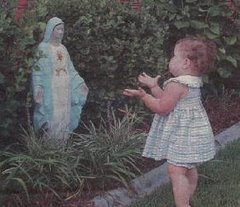
If you've noticed my new sidebar, there is a picture of a tiny little girl talking with her hands to a statue of the Blessed Virgin Mary. The caption says "Teach your children to pray," the first thing to teach a child.

The second thing to teach a child is, "Teach your child to work." When I find a suitable picture, this recomendation also will be added to the sidebar. The third thing will be to "Teach your child to help others." We'll get to that one in a later post.

Aug 28, 2006

Fire in the Crown -- Time for Regrowth

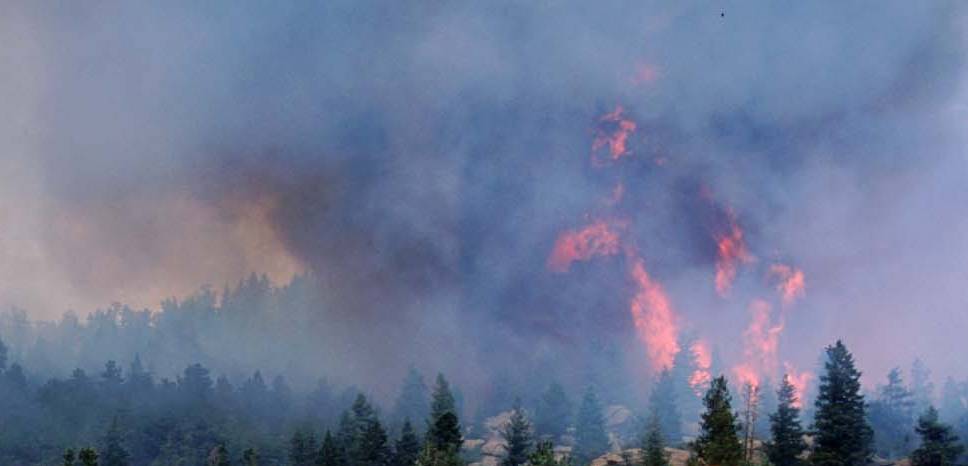
Compare the past forty years in the Church to a blazing forest fire that lasts only a few weeks, at most. Yellowstone's summer-long fire in 1988 is an exception. Yellowstone's former policy was to suppress all fires; unfortunately this created favorable conditions for huge infernos.

When an inferno reaches tree crowns in the upper reaches of the canopy, even trees hundreds of years old will die. How long does it take for new trees to germinate and grow so that you can see their green color again? Only a few years, yet when I visited Yellowstone two years ago (16 years after the fire), the new trees were less than 10 feet high. How long does it take to get marketable timber in a well-managed forest? Usually 40 to 80 years; less for some specialty woods. How long does it take to restore the really valuable old-growth trees--hundreds of years.

The fire in the Church reached the tree crowns. The old trees died in the terrible blaze, but even though dead, they still stand--yet without branches and no longer providing habitat for birds and animals, nor do they produce new offspring.

Certain religious orders are examples of the old-growth trees which have burned, but there are others. Do we see a small amount of green again? Yes, mostly in the Latin Mass communities. How long will it take to get marketable timber in large quantities--probably at least 80 years.

Aug 27, 2006

Missouri Stem Cells

Michael Cook, the Australian editor of MercatorNet, sees the importance of the Missouri Stem Cell Initiative to be voted on November 7. He is convinced that the decision that Missouri voters make will have far-reaching effects upon public health, science and law.

NFP Courses and My Apology

KCPriest at Sacerdos in Aeternum asked a question of his readers back on July 14 about teaching NFP to engaged persons and what constitutes "grave necessity." His short post received 66 comments, some of which seemed excessively argumentative. KCPriest stated in his post that he fully intends to post again on the subject of NFP.

I wrote a post saying some of the discussion at KCPriest's blog was overdone when compared to China's policy of one-child families. I received a comment recently that correctly asked:
You can't mean to imply that everyone should have just ignored the good Father's request for dialogue on the subject?
I attempted to answer that comment, but still feel my response was not very good. Well, I'm backtracking, and apologizing, too, to all the persons who argued from their heart and soul on a very important issue for Catholic families.

Why? Because of the last comment shown above and especially because of reading "NFP courses: Asking questions can be helpful," a new article by John F. Kippley in the August/September issue of Homiletic & Pastoral Review. I hope all parties participating in the original post by KCPriest read this article that emphasizes NFP instruction must respect the norms of modesty and encourage chastity. The article asks priests
Do you want your engaged couples to attend a course that seeks to elicit a decision for marital chastity and Christian discipleship or a course that seeks to be only an anatomy-physiology course on human reproduction?
Kippley and his wife founded the Couple to Couple League for NFP in 1971 and they have recently formed NFP International to continue their work internationally, especially in Eastern Europe. They now have concerns about some of the NFP courses being taught, especially the Fertility Awareness Method (FAM). FAM is stated to teach women how to monitor their fertility so they can use sinful contraceptive behaviors only during the fertile time.

Kippley states:
Catholic priests who want to promote and teach marital chastity through NFP instruction need to be aware of significant difference in NFP programs...Common sins [to avoid pregnancy in the fertile period] need to be addressed...it is clear that dioceses and NFP programs have to be more clear and explicit about the moral use of NFP.
In particular, Kippley says that priests who recommend NFP courses should ask questions of those persons teaching NFP.

With regard to comments on a prior article in HPR by Fr. Chad Ripperger, FSSP, on "Immodesty unrecognized--the problems with teaching NFP." Kippley says that
Fr. Ripperger is right: bishops, priests, deacons, and marriage preparation personnel may be sending engaged couples to NFP instructions in which the norms of modesty are ignored.
In the future, I expect to see and welcome more dialogue on "serious" vs. "grave" reasons to practice NFP.

Aug 26, 2006

Beyond Vatican II

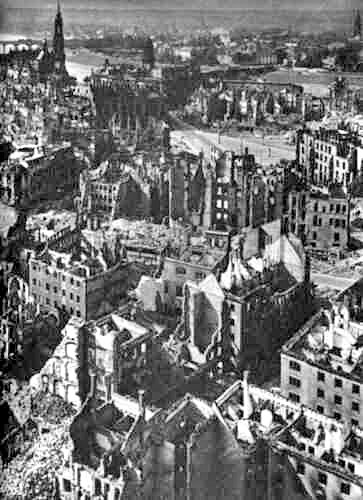
Photo: Aftermath of Dresden Firebombing

Homiletic & Pastoral Review typically has an editorial on the back page written by the long-time conservative editor, Kenneth Baker, S.J. The August/September 2006 issue just arrived with an editorial entitled "A Church in Transition." Fr. Baker summarizes Fr. Claude Barthe's book, Beyond Vatican II: The Church at a New Crossroads:
  1. The Church is seriously wounded (a long list of indicators)
  2. The Church is self-paralyzed and does nothing to heal herself
  3. The Church has replaced a hierarchical government with a democracy--thus becoming a federation of sovereign states, with a weak central government
  4. The Church is now ungovernable and everyone does what he pleases.
Fr. Baker seems to concur with Fr. Barthe's evaluation that the basic problem is the Vatican II document on ecumenism, Unitatis Redintegratio, which led Catholics to believe that sects with their heretical views can be treated as equals. [Incidentally, I find it hard to believe that traditional Catholics haven't added to Wikipedia's description of this Vatican II document.]

Is Barthe correct to claim that there are encouraging signs on the horizon? Yes, I believe the Church under Benedict XVI will:
  • 'disengage' from Vatican II (but it will take a few more years);
  • generate new priests who will attempt to restore the Church;
  • begin the restoration and renewal of the Church with a small set of reforms.
Will the Church recover anytime soon from her wounds? No.

The damage that has been done to the Church and her people is so bad that no man, even a Saint, can restore the Church to health within my remaining lifetime--a maximum of 30 years. Why do I believe this? Because Jesus' parables use nature to teach us truths, and nature is a good illustrator of spiritual dimensions. For example, read Luke 13:6-7 with the parable of the fig tree that did not bear. Also see Kipling's poem, God of the Copybook Headings, about the unforgiveness of nature. God can forgive sins, but nature does not.

Aug 25, 2006

The Wanderer and Church Closings

I've subscribed to The Wanderer newspaper for almost 40 years, even before highly respected Walter Matt (1915-2002) resigned as Editor and formed The Remnant newspaper. At times, I've thought The Wanderer did a great deal of good, especially informing Catholics of their faith; at other times, I wondered if I shouldn't do without them. An example of what I'm talking about can be see in the example May 26, 2006 front page with two articles that seem to be goo-goo-eyed over the appointment of Archbishop Levada of San Francisco as the prefect of the Congregation of the Faith.

The Wanderer's policy is governed by two rules: (1) never criticize the Bishop of Rome, no matter what administrative decision he makes; and (2) criticize the other Bishops all you want (but not quite all of them). The problem with the first rule is that the Pope is not impeccable--he can and will make some mistakes, and recent Popes have made some doozies. The problem with the second rule is that The Wanderer assumes that if they expose a problem, then faithful Catholics will be able to fix it. Wrong, again!

In addition to prayer (always effective), faithful Catholics have three tools to deal with bad Bishops and their bad decisions--only two of which are somewhat effective. Lay Catholics have their voice, their feet, and their pocketbook. After 40 years of using voice and pen, I can vouch for their almost complete INeffectiveness in stopping the bludgeoning of orthodoxy and traditional Catholic practices. First of all, very few Bishops will respond to a problem identified by a layman. Second, try as you may (and in concert with many others) the Pope won't respond--except in a very few instances. Oh, yes, the local Bishop may send back a nice letter--but you'll have a hard time getting most Bishops to effectively respond to serious problems. [Fortunately there are a handful of exceptions in the U.S. and these good Bishops are increasing]

So where does that leave a Catholic who wants to attend a local church not infected by Modernism? He can vote with his feet and attend a Novus Ordo (NO) church that retains a semi-traditional priest who has made compromises to stay an active pastor, but yet promotes a few traditional practices and gives acceptable homilies. Or a Catholic can transfer his membership to a church affiliated with the Society of St. Pius X (SSPX). Some of my friends over the past 40 years went one way and some went the other.

Those who stayed in a NO church came to realize that this solution usually was temporary, so off to another church they went--in some cases, even to a church in another diocese. It wasn't until the indult Latin Mass was allowed in a very few places that a third choice was available. Even then, Catholics who attended the indult Mass were often viewed as temporarily on the fringe of the Church until they could be fully reintegrated into the NO community.

Back to The Wanderer. The new issue of August 24, 2006 has several good articles that make me happy that I've not yet canceled my subscription. First of all is an article (second of three parts) with a lot of irony about "How Anne Burke Surprised the U.S. Bishops." Mrs. Burke is the Illinois Supreme Court Justice who was second-in-command of the Board appointed by the U.S. Bishops to study priestly pedophilia. She assumed leadership when Gov. Keating resigned in disgust. There's a fair amount to disagree with in the article of her interviews by Thomas F. Roeser, but it is an interesting read of why some liberal Bishops seem to wish they had never heard her name.

The second article is on a local subject, "Cloning Measure Would Ax Laws Regulating Abortion." Jennifer Brinker outlines the November 7 ballot initiative on the "Missouri Stem Cell Research and Cures Initiative." She points out that Missouri has several laws dealing with aborted human beings that would be overturned if the Initiative passes.

The third article of interest is about a New Hampshire parish merger and likely church closings. A woman (state legislator) is appealing to the Vatican, asking the Holy See to reverse the merger of three parishes in the Lakes Region and to prevent the closure of a parish. [The lady admits this effort is not likely to succeed.]

Church mergers/closings in New Hampshire are occuring as a result of recommendations from Cluster Task Forces (example here) assembled for long-ranging planning--a process that sounds very similar to the Task Forces being set up in the Kansas archdiocese. Some of the comments of the appellant woman include:
The real reason for the consolidation is to retire the debt.... Once you merge, the money all goes into one pot. There's no reason for this merger other than the money....

...input from the parishioners was given short shrift in the [Task Force] process. They allowed people to come and talk, but they didn't act on any of those suggestions. They didn't listen. Their minds were made up. The whole thing was a farce.

You mean to tell me the mighty Catholic Church can't get a priest to come to St. Agnes (the parish to be closed) for one hour a week?
Finally, another woman supporter noted:
In this town we have an Episcopal church, a Methodist church, and a Baptist church, and none of them have the amount of people going to their churches that we have. But they're not giving up their churches.

Aug 24, 2006

Serious Gardening for Kids

In the summer when I was ten, Mother raised almost two acres of grapes, long rows of black raspberries and strawberries, and other plots of green beans, cucumbers, tomatoes, and other vegetables. My younger siblings and I assisted Mother with gardening, and I was usually allowed a 15-min break after every 15 to 30 minutes of work.

Dad grew up a city boy and worked at construction jobs. He bought a small Farmall tractor from the government after WWII to plow, cultivate, and cut grass and hay. Big jobs were his, such as some barnyard work, building and maintaining fence, using the tractor to plow and cultivate, and installing the posts and wires in the grapes. Mother was responsible for the gardening work which brought income for the family when Dad did not have a job.

My first gardening job in the early spring was to tie the grapes when I came home from Catholic grade school. Mother would have already trimmed the grapes to leave only strong vines for new bunches of grapes to grow, or new lower vines to initiate strong vines for the following year. I occasionally helped her cut old clothes and other waste fabric from feed sacks used to sew new clothes. The waste material was used to make 3/4 to 1" wide by 6 to 10' strips that were used to tie grape vines to three wires strung on posts in each row. It was a matter of intertwining a grape vine through the wires, being very careful not to knock off any buds, and using a strip of material to tie each loose vine as upright as possible to the wires.
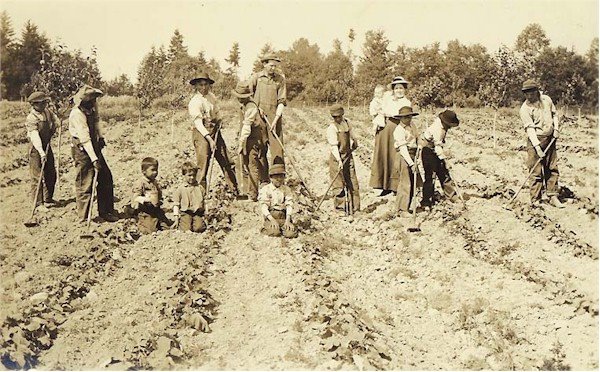
1912 Photo of Boys Hoeing
Hoeing was the most frequent gardening work and it started quite early in the spring. Mother was insistent that weeds were much easier to control if you hoed them when they were small. We learned to use a heavy hoe only when weeds infrequently grew large, such as during a period of constantly rainy weather when hoeing was impossible. Otherwise, an old hoe with a well-worn thin blade was much more productive at cutting the tops of small weeds from the roots. Mother explained that shallow hoeing was preferable to control weeds, with deep hoeing used only when absolutely necessary.

Mother always took a steel file with her to the field to keep our hoes sharpened. Before she used a new hoe and several times afterward, the old hired man of my Grandma would use a hammer and an anvil to pound out the leading edge of the hoe. I remember the loud ring of the hammer on the hoe's cold steel, and I think there is still an anvil in Mother's basement made of an old railroad rail. Only after the hoe's edge was hammered thin would the valuable steel file be used to put a sharp edge on the hoe.

Sharpening a sickle was quite different than sharpening a hoe. The cutting edge of a sickle was used to cut weeds near an obstruction, such as a wall or post. Because a sickle never was supposed to hit anything hard and only cut weeds, its edge was much more important to get absolutely sharp. So a wet stone was used for honing the sharp inside edge of a sickle, rather than the steel file used to sharpen a hoe.

A frost or freeze easily damages strawberry blossoms which was the first crop harvested in the spring (except for rhubarb and asparagus). If frozen, a strawberry blossom develops a black center and no strawberry grows. If Mother said it was going to freeze (and absolute quiet was insisted during the radiio weather forecast), everyone helped cover the strawberries before it got dark. Old quilts, blankets, sofa covers, etc. were used, but newspapers and straw or hay were the primary material used for cover. To keep newspapers from blowing away, a hoe was used to pull dirt around the edges of the newspapers.

Small fragile tomato plants were also protected by newspapers, by making a small hat to cover each plant with a couple of thicknesses of newspaper. In the mid 20th century, the Kansas City Star and Times came twice a day, and they were large, well-read newspapers. If the freeze/frost was not forecast to continue, the cover material was quickly removed the next morning so that the plants could receive warm sunshine.

One year the spring was wet and warm and the strawberries began to easily rot, so Mother recruited all of the family, including Grandma, to help with the picking on an every day basis. Normally, we picked berries every second day--including Sunday. The Church and priests knew that crops were less desirable or could be lost if harvesting was delayed even by a day, so it was considered necessary servile work.

My Dad was home that morning after it had rained the night before and there were a lot of wet strawberries to pick before it became hot. Dad failed to show up in the field and Mother was obviously not happy because the heat combined with the rain would make the strawberries unsuitable for sale. Dad explained that he couldn't stoop to pick berries as easily as his small wife, and he needed to make knee covers so he wouldn't get wet. Mother was clearly frustrated because she was working as fast as she could and it took Dad a long, long time to make those knee covers. He finally showed up in the field with his rubber tire knee covers when Mother and the rest of us were picking the last row. Mother looked at the size of the knee covers and said he would damage the plants with those huge things. I don't remember if Dad picked more than a box of strawberries that day.

I learned that when strawberries and raspberries are picked for sale, the picker carries a 4-legged wooden stand that holds four to six boxes in which to put the berries. The biggest and best berries are saved in one box as another box is filled with the regular run of berries. When the box of smaller berries is almost filled, the saved larger berries are placed on top to make them easier to sell in competition with other growers.

With the berries tat were too small or too ripe, Mother would can as many as 80+ jars of strawberry preserves which she used for breakfast toast, school lunches (strawberry and butter sandwiches were my favorite), and homemade strawberry ice cream. My job was to stem the strawberries so that Mother could cook and can them. I learned to avoid cutting into the strawberry to remove the stem. One time I had to go back to the discarded stems and recut them to remove small pieces of strawberry.

Strawberries are not thorny as are black raspberries, but you can stand while picking raspberries. Standing to pick raspberries is much better than bending over or kneeling in strawberries--take my word for it. When I was ten, we had a very good crop and Mother picked over eight crates of black raspberries in one day. [Each crate held 24 pint boxes.] She was very tired and told me that evening she was so proud of me because I stayed picking to help her. That day, I picked 26 pint boxes of the small berries.

How fast and good a berry picker was my Mother? After I married, I planted a strawberry patch on very good soil where a pig lot had formerly been located. The first crop was of many large berries and Mother came to help me pick. Without telling her, I decided to pick as fast as I could (remember, she was in her mid 50s and I was in my mid 20s) and determine whether I could beat her.

The result was that after I worked as fast as I could to pick two boxes of strawberries, Mother had already picked four boxes and hers were arranged nicer than mine. She explained that when she was quite young, her older siblings made fun of her for picking so slow and called her "slowpoke." Mother told me she was very mad at being called a name and said she practiced picking fast and faster so she could keep up.

Aug 23, 2006

Evangelism in Latin America

The Australian news site MercatorNet is the best Catholic news site I've seen with its excellent commentaries that have previously been recommended by other Catholic bloggers, including Fumare, Amy Welborn, and Curt Jester. One recent news item you don't want to miss is entitled Latin Rapture.

In the MercatorNet article, two Catholic priests in Latin America comment on the huge growth of Protestant Pentecostals in the last 30 years. Some of their very interesting observations:
  • “I believe that if Latin America is still following a Christian path, it is thanks to the evangelicals”
  • n 1900 there were only 25,000 evangelicals in all of Latin America. Now, in Argentina, there are said to be four million Pentecostals and in Brazil 25 million. In Brazil it is claimed that they represent 18 per cent of the population; in Chile 25 per cent; in Colombia 35 per cent; and in Guatemala 45 per cent. (Exact figures are hard to come by.)
  • “Those 16th century Protestants have turned liberal; they accept, for example, abortion and gay marriage,” says Father Julio Elizaga, a Catholic priest who has been working in ecumenism in Uruguay and Latin America for 56 years. “That’s why their churches are empty. The Methodists used to have around 3,500 to 4,000 members in Uruguay. Now there are just 500”
  • “official figures show that in Latin America 11 per cent of the population is evangelical, most of them practising. Pentecostals don’t have two groups of mere believers and practising believers... Some people say that they are Catholic but never go to Mass. This doesn’t happen among the Pentecostals.”
  • How did the Pentecostals seize the initiative? Pastorino argues that Catholics took their eyes off the ball. “In the 1960s part of the Catholic Church followed the ‘progressive’ ideas of the day. Even its language become more sociological; it sidelined mysticism and eschatology,” Pastorino said. It was also a time when, says Father Elizaga, more than 100 priests walked off the job in Uruguay. The door was open for the Pentecostals.
  • However, like most Protestant denominations, Pentecostals are a fractious lot and this hampers their growth in Latin America. “Pentecostal churches are divided; they have neither an authority nor an episcopate. This is their worst problem,” says Father Elizaga. “If they maintained a united front, they would be a devastating force”

Aug 22, 2006

Boston, Creating the Vacuum

Since the late July simulation of priestly ordination of a woman department head in the Boston Archdiocese, I've been perusing the latest news about Boston under Cardinal O'Malley. According to Carol McKinley, a four-year blogger who posts daily items about the devilment going on in Boston, there is little good happening in Boston. Catholic Charities has defended adoptions by homosexuals, priests are leaving for sabbaticals and women, parish collections are falling, people are leaving the active practice of Catholicism, etc.

Financially, the Boston newspaper says the Archdiocese of Boston 'claims' [notice the paper doesn't use the word 'has'] nearly 2 million Catholics in 144 communities. In some ways, the Archdiocese still appears to be rich in a materialistic sense, with over 1,500 buildings in Eastern Massachusetts--estimated replacement value of $2.8 billion. It employs 3,000 people and oversees hundreds of parishes, schools, cemeteries, hospitals, and social service organizations.

While the archdiocese and its parishes have $330 million in assets, officials say financial restrictions and debt total $376 million, resulting in a $46 million gap--a big chunk of change. Despite having laid off dozens of employees, the archdiocese is also running an annual operating deficit, and it faces serious ongoing problems from diminished attendance at Masses, decreased school enrollment, a shortage of priests and nuns, massive maintenance costs for old buildings, etc.

The financial statement from the Archdiocese of Boston shows depletion of assets by selling old church properties. Even though fundraising costs increased 16% from $1.9M to $2.2M in 2005, revenues decreased 6% from $31.6 to $29.6.

Is Boston a bellweather of future diocesan problems through the U.S.? Like California is the bellwether of social problems carried by westerly winds across the rest of the country? Or will prevailing westerlies mostly carry the religious problems of Boston out to sea to drown in the abyss (or maybe carried to Ireland).

Regardless, a vacuum is being created in Boston--of priests, money, Catholicism, etc.--a vacuum that will subsequently be filled one way or another, either with bad or with good.

Aug 21, 2006

Dignitas Connubi (DC) and Annulments

The purpose of the Vatican document, Dignitas Connubii (DC) is designed “to offer the ministers of justice who work in ecclesiastical tribunals a practical Document, a sort of vademecum that will serve as an easy guide to enable them to handle their work better in canonical processes of matrimonial nullity.” When DC was issued in February 2005, it was compared to a similar Instruction, Provida Mater, issued in 1936. The old instruction, Provida Mater, consisted of 240 articles, while the new DC is a somewhat weightier document with 308 articles.

The Code of Canon Law recognizes the following grounds as invalidating a marriage: force or fear; ignorance, error; fraud; intention against fidelity; intention against children; intention against permanence; intention against partnership of life; lack of reason; grave lack of discretion of judgment; and inability to assume the essential rights and duties of matrimony.

So how goes the implementation of DC? Is the new Vatican instruction issued in early 2005 having an effect on annulments in the U.S.? Or is DC like a lot of post-Vatican instructions that have been ignored?

The Canon Law Society of America (CLSA) is a good place to start to see whether DC is being implemented. The annual convention of the CLSA is scheduled for October 9–12, 2006 in Fort Worth (at a $160/night hotel, plus taxes). A pre-convention workshop will be given on Rota Jurisprudence and Formal Marriage Cases. The workshop will explain recent Rotal decisions that impact marriage. Attendees will likely see an expanded list of reasons for nullity of marriages, because the announcement for the workshop says “Other grounds of nullity that have seen development will be presented…”

The 4-day conference program identifies two presentations on marriage. The first one deals with “Negligence, Dolus, and Personal Canonical Liability in Tribunals.” Apparently DC explicitly allows for legal actions for personal damages against tribunal personnel in case of their negligence. The CLSA is clearly concerned about being sued for damages that could be considerable, particularly if they involve reimbursing wedding expenses.

The second presentation considers the bonum coniugum as an essential element of marriage and as a possible exclusion in the processing of a marriage nullity case.

A new book on DC, , Dignitas Connubii: Norms And Commentary, is expected to be released right before the CLSA conference. It sounds like this book will ‘interpret’ DC. After all, how can you apply Canon Law and the 308 articles in DC without a book that explains what DC means? I think this really means that tribunals are struggling with, delaying, or interpretating DC in the most liberal way they can. Don't look for a solution soon to the problem of annulments that sometimes serve as "Catholic divorces."

Aug 20, 2006

Unsettling Statistics on European Religious

My husband believes the annulment flood over the past 40 years should be made a critical topic among Catholic bloggers. Looking around, I found the Feb 8 2005 announcement of a press conference describing Dignitas Connubii that was issued to tighten up 'loose' proceedings in granting annulments, especially in North America. The press conference referenced world-wide annulment statistics from 2002:
It is first of all necessary to provide some statistics concerning causes of matrimonial nullity. The source is the Annuario Statistico della Chiesa for 2002.
The year 2002 seemed a little old so I tried to find a later statistical report.

A search revealed a very interesting Word document simply titled "1" found in the files of chiesacattolica.it. Dated June 1, 2006, the document was edited by Mons. Antonio Ladisa and presents data on religious vocations, especially from Italy as compared to the rest of the world (but none on annulments). Ladisa is studying the vocations crisis in Europe and trying to determine whether the crisis is happening everywhere or only in some locations.

The first table in Ladisa's report presents 1977-1997 figures on the numbers of priests in five regions of the world. Religious vocations in Europe are compared to worldwide numbers. The key statistic is that Europe constitutes 30% of the world-wide Catholic population, but produced (in 1990):
  • approximately 60% of the total of diocesan priests (153,000 of a world-wide total of 261,000);
  • 46% of religious order priests (66,400 of 142,900);
  • 52% of religious (442,000 of 848,000);
  • 43% of the religious brothers;
  • approximately 80% of the members of Secular Institutes
The above data appear disastrous for the future of the church. A very high percentage of world-wide religious vocations in 1990 came from Europe, but Europe now is producing significantly fewer numbers because of a scarcity of children and decreasing Catholic religious practices.

The table below easily shows this very unsettling problem. The number of secular institute priests and nuns from 1990 to 2004 are shown. A world-wide decrease of almost 8% is noted, and almost all of the loss is caused by an 18% drop in European priests and nuns that in 2004 still constituted 72% of the total world-wide members of secular institutes. In other words, large percentage increases in Africa, America, and Asia did not make up for the large loss in European members of secular institutes.

Membri istituti secolari

Continente

anno 1990

anno 2004

variazione

Africa

451

528

17.1

America

4,757

6,043

27.0

ASIA

892

1,527

71.2

EUROPA

25,272

20,800

-17.7

OCEANIA

47

44

-6.4

Mondo

31,419

28,942

-7.9

The document identifies the numbers of 1998 ordinations in each Italian region, notes that foreign priests are needed, and goes into some detail about their characteristics. Almost 1,700 foreign priests serve Catholics in Italy.

One hopeful statistic in the report deals with cloistered nuns in Italy that increased from 5,000 in 1978, to 7,651 in 1998.


Writing the Story for the Boston Vacuum

Carrie Tomko has identified the coming vacuum in the Church as liberal Catholicism ages and dies. Who and what will be poised to enter the vacuum? How can the vacuum be filled with a renewed Catholicism?

The story of filling the vacuum must be written now, as a historian would write from at least 100 years perspective. Some call 'writing the story' a vision or a long-range plan. Whatever it is, you pretend to be a historian, decide what year you want to start, choose the environment, and decide what should happen to achieve a future goal--in this case, restoring the Catholic Church.

Let's start with the Boston Archdiocese, arguably the most notorious un-Catholic environment in the world. With God's help, how could Boston be revived from its dissolution and desolation? Yes, this may be the most difficult environment in which to develop a vision of the future!

What does the Boston Archdiocese have in 2006?
  • Total lack of confidence in the Archdiocese by Catholics who still want to remain faithful to the Church founded by Jesus Christ
  • Bitter memories of the homosexual sex scandals affecting the priesthood
  • Loss of property similar to church confiscations by Communists in foreign countries
  • Terrible demoralization of the priesthood, leading to further losses of existing priests and few candidates for future priests
The only successful story that a historian of 2100 could write for Boston would have to start with a few great saint(s)--preferably the Archbishop himself and a small group of very saintly priest(s) given special responsibility to restore the Catholicity of Boston. Only saints can identify the path Boston really needs to follow and could motivate other priests and laymen to become saints and rebuild the Archdiocese.

Assume the remaining faithful Catholics of the Archdiocese pray fervently to God who answers their prayers by giving them a very few saintly priests and at least 10 saintly laymen--not just good men, but SAINTS. In order to succeed, the Archbishop would have to publicly state that these priests have been given a special charge to rebuild the church in Boston. [An alternative would be to bring in a great traditional order of priests (e.g., FSSP) and give them the responsibility.]

For the first two months, small groups of rotating pastors would be required to attend a special 4-day retreat given by the saintly priests to prepare the pastors and their people for a special Lent of mortification, fasting, and penance. The pastors would be told by the Archbishop that the saintly priests would be given special responsibility for restoring the Catholic Church in Boston.

After the retreats, the saintly priests would travel to key churches in the Archdiocese to say Mass and give sermons--at the prime Sunday Mass times and as the special representative of the Archbishop. On four days every two weeks, each saintly priest would choose a parish in which to give a retreat or mission. And it would be a hard mission that required confession, significant meditation, and sacrifices (not an eat, meet, and retreat conference). The mission would clearly identify the problem with the Boston Archdiocese are SINS of God's chosen people, their own sins and omissions and those of others that allowed the Boston Archdiocese to descend into chaos. The priest would promise the people that if they did sufficient penance their local church would be restored. During a 6-day rest period each month, the saintly priests would be recharged with their own retreat and days of recollection. The Archbishop would listen to their stories and encourage them to continue their important work.

At first there would be a lot of complaints and even further, possibly major losses of priests and money, if I read Boston correctly. The Archbishop, even in the face of initially adverse results, would continue to actively and publically support the saintly priests that he had given his special charge. At the end of a year, the Archbishop would receive a status report from pastors of parishes where the saintly priests had given retreats--to determine the trend in the number of daily communions and weekly confessions--which should definitely increase! However, money receipts during this period might have fallen.

[to be continued in "Boston, Filling the Vacuum"]

Aug 19, 2006

Mateo Ricci--Jesuit Inculturationist

I had thought that Fr. Teilhard de Chardin S.J. had pretty much passed into oblivion, but here comes Fr. Peter Hans Kolvenbach. father general of the Jesuits, who compares Chardin to Fr. Mateo Ricci, who traveled to China and became the court mathematician in Peking. I find the comparison interesting because both of the named Jesuits compromised and adapted their Catholic faith to the environment of the time. Both inculturationists were disciplined by the Church.

Ricci was a Jesuit missioniary of the late 16th and early 17th centuries who spent the last 27 years of his life living and dressing as a Chinese scholar, and is considered a leading inculturationist who incorporated Chinese religious beliefs into Catholic liturgy. Because the practice of ancestor worship was so deepseated in Chinese society, Ricci allowed the new Chinese Catholics to continue with the ceremonies that honored the dead and Confucius. He also used certain Chinese terms to designate God that were later declared incorrect by Popes.

After much controversy and the passionate defense of Ricci by the Jesuits, the accomodations of Fr. Ricci to Chinese paganism were condemned in 1742 by Pope Benedict XIV in the Bull "Ex quo singulari." The Bull required the missionaries to take an oath that such abuses would not be tolerated in the future. Ceremonies in honour of Confucius or dead ancestors and relatives were said to be tainted with superstition to such a degree that they could not be purified.

In July 1983, the Red Chinese published a laudatory piece on Fr. Mateo Ricci. Seizing on this possible opening of Chinese Communism to Christianity, an International Convention to honor Mateo Ricci was held in in Rome during October 2001. The conference was sponsored by the Pontifical Gregorian University and the Italo-Chinese Institute. In a message to participants, Pope John Paul II called for the normalization of diplomatic relations with Red China. He also apologized to the Chinese for errors and actions that the Church in China had committed in the past. Enuff said!

Saintly Service in the Closet

I've been privileged to know a few people who have given saintly service to the Church, yet who will remain mostly unknown in closets of the past. One is a lady who has been dead for over ten years. Her life seemed to be divided into four parts--a very exciting international life before marriage; a happy life with a nice house, couple of kids, and golfing at the country club; a challenging life with a child that brought her into pro-life work, and a more difficult yet serene life when she was mostly homebound because of her health.

My friend was a great letter writer. Many times I would read her commentaries in public and church newspapers and magazines. She was distinctive in that her submittals were often the shortest letters published, yet they usually said the most.

It was her private letters that gave the most saintly service to the Church. She wrote many, many letters of encouragement to good priests who were tempted to leave the priesthood. The priests knew they were being robbed of their dignity and identity in Catholic churches during the 70's, 80's, and early 90's. They felt emasculated by limitations on their authority, certain women given responsibility for priestly duties, and mandatory retreats that left them dry of spiritual life.

From the little my friend would tell me, I knew she corresponded with a goodly number of these priests with her regular letters. Without her encouragement, I believe many good priests would have simply walked away from the horrible messes following Vatican II. Yet these good priests stayed to give the sacraments to faithful Catholics, even though sometimes they were severely limited in what they could and should do.

Esther, May God bless and reward you for your letters of encouragement to priests.

Aug 18, 2006

Large Houses and Lost Sippy Cups


All of our children now have larger houses than we do. Do I envy them? Oh, no! Both my husband and I think a large house is more of a rock around the neck forcing us to spend more money and time than either of us want to give. In addition, a large house requires a lot more effort to clean. I find my own housecleaning a real chore, and I live with the continuing promise of cleaning tomorrow, because I have more important things to do today.

I've just finished babysitting for one of our youngest grandchildren while her parents camped at a nearby lake with the older children. The toddler was good and I had extra time, even to make some brownies. My daughter wants me not to work excessively when I come, so she had gotten her children to help her clean the large house, and it appeared cleaner than mine.

Why is it that I always look for dirt to clean when I go to my children's houses to babysit? It is clearly an unnatural vice, because I always avoid looking at the dirt in my own house. Is it a problem with my eyesight? Or with my focus? Really, I just want to help my children because their large houses often have a lot of variety in cleaning opportunities. And the reward is greater because I usually get hugs and thank you's when my work is done.

The first thing I did after I arrived was to try to find a clean sippy cup so the toddler would not spill her milk. A sippy cup is made of three parts--the cup, the valve, and the lid through which the baby sucks the drink. The sippy cup drawer was full of misaligned parts, and only one lid fit with any of the clean cups, although a couple of correct valves were available. I decided to find some of the missing parts that I knew must be hidden around the large house.

Unless one counts the wastebasket, the most likely place to find missing toys (my grandchildren's greatest sorrow in life) is under things--under the table, under the sofa, under the bed, etc. From experience, I know the most promising place to look for baby bottles and sippy cups is under beds. As I went from bed to bed, I picked up the skirt and peered into the semi-darkness. I immediately found junk, otherwise known as my grandchildren's treasures. Moreover I found dirt--the most evil substance in the universe. [Sorry, League of Evil Traditionalists, you don't come close to matching the REAL thing.]

Success! I found three pieces of sippy cups under the seven beds. I also found an old baby bottle (which the toddler no longer uses) and a complete sippy cup assembly (yes, the milk was curdled into the solid part and the liquid part).

I'm sure my daughter thought her house looked clean enough that I wouldn't look and I wouldn't clean. Old grannies, at least this one, just can't help themselves.