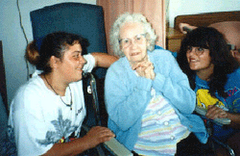
Lucy was my spiritual Godmother. I adopted her in my late 20's because she quickly led me to a much fuller understanding of what a militant Catholic ought to be and do. She introduced me to The Wanderer and many other Catholic periodicals. She paid for me to attend a Catholic conference out of state. She sponsored several days of recollection led by good priests. She held a free banquet to celebrate Cardinal Mindszenty's anniversary. Lucy served the Church in ways too numerous to mention--many of which occurred after she turned 65.
Shortly before she died in her 80s, I knocked at her door. When she opened it, I gave her a bouquet of red roses. She looked puzzled and asked "Why?" I responded that she should receive roses before she died, not afterwards!
Lucy was the first one who spoke to me of the devilment coming to the Church after Vatican II. She knew her Church history and contemporary Churchmen, and predicted that a catastrophe was in the making. She said she would never see the restoration of the Church, and she was not sure that I would see it in my lifetime. Her death in the late 1970s was a great loss to Kansas City Catholics.
Lucy particularly liked the poems of Rudyard Kipling, an English poet of the early 20th century. One time we talked about the problem of "sexual freedom." She told me of The Ladies, a poem that continues to be remembered whenever I read or hear about men and women living together in sin.
Kipling's poem describes a British soldier who goes from woman to woman as he is stationed to different posts. The poem ends with the warning:
've taken my fun where I've found it,
An' now I must pay for my fun,
For the more you 'ave known o' the others
The less will you settle to one...
Jul 8, 2006


Jul 6, 2006
Hope, Hope, Even More Hope!
Fellow KC blogger, WolfTracker at http://kansascitycatholic.blogspot.com/, has quoted parts of a June 25 interview with the Sri Lanka Archbishop who was appointed late last year as secretary for the Vatican Congregation for Divine Worship. As a member of the Roman Curia, Archbishop Albert Malcolm Ranjith Patabendige Don supports a new reform of the post Vatican II liturgy which he admits had "negative results." In a supplementary news article at Catholic Exchange, the Archbishop states the Pope "is reflecting and we are waiting for his indications" regarding the expanded use of the pre-conciliar liturgy [i.e., the old Latin Mass].
It is no secret the indult Latin Mass communities are growing in Kansas City. A 6-page report recently distributed by the Kansas City, Kansas community documents the well-attended and very reverent daily Masses, 15+ hours of confessions offered each week, weekly Benediction, frequent processions, three recent vocations, almost three infant Baptisms per month, Catholic action in multiple ways, and regular community social events. Most importantly the Latin Mass Community of St. Philippine Duchesne served by the Fraternity of St. Peter has now grown to 374 children and 357 adult members. Think of that! More children than adults in a Catholic church! See their web site at www.latin-mass.org.
Great things are also happening in Kansas City, Missouri where Bishop Robert Finn has assumed the role of pastor of the Latin Mass community in his diocese. The Institute of Christ the King assists the Bishop in serving Old St. Patrick Oratory. This downtown church is now being rebuilt at some expense and hopes to reopen in early 2007. See http://www.oldstpatrick.org/ for a lot more information on their lively parish life. In particular, their color bulletins published before March of this year were the most beautiful I've seen and are still available on their web site.
Jul 3, 2006
Soup and Slop
Growing up on a small farm has given insights into much of life. For example, my siblings and I learned the difference between soup and slop.
We kept a slop bucket on the back porch. If we couldn't finish our meal, the remainder went into the slop bucket. By the time the slop bucket was full, it contained potato peelings, greens from carrot tops, cabbage leaves with worm holes, leftovers from three days ago, and old milk from the cow. Quite nutritious for pigs, but none of us kids would dare to eat it.
My grandmother prepared very tasty soups for her grandchildren. Soups are very nutritious. They can have most colorful and tantalizing ingredients. Almost everyone likes to eat at a restaurant with a chef who can make delicious soups. A good soup is one of the joys of this world.
So what is the difference between slop and soup? Really not much as far as ingredients goes--a little bit of water, vegetables, cheese, a small amount of meat. But there is a big, big dissimilarity!
Here are some examples of soups and slops in the modern world. Remember, they all consist of the same ingredients. A good book versus a pornographic one. An intelligent opinion versus a stupid statement. A virtuous woman versus a promiscuous one. Yes, some people can't tell the difference between soup and slop.
Fireflys
Many years ago, a man in Lawrence used to pay children one penny each for fireflys. He wanted to find out what made a firefly blink. Fortunately, fireflies were not exterminated and we still have them. This evening after it stopped raining, I worked to stack wood branches. In the glade between the trees, the fireflys blinked and blinked.
A firefly blink is somewhat like a turn signal on a car, or a flashing light on your phone. Even though it is very faint and some distance away, the blink of a small firefly attracts attention. Who can ignore fireflies?
Over the past 60 years, I've known a few good Catholic fireflies. They're shy individuals who don't shine very strongly or for very long, but their humble faith turns their light on regularly--like a firefly.
Faces of Men - Part III
I met Mr. P. on Highway W several years ago. I said to him without thinking, "God wants you in heaven." [Seriously, I've never done anything like this before or since.] Whether Mr. P. was surprised or not is not clear. We talked a lot after that and somehow I believed (and still do) that God has destined Mr. P. for great things--and I told him so.
Mr. P. revealed he had no faith because he had been raised a communist. He described his Christian heritage, but it was from several generations ago. His great grandmother wanted her son to become an orthodox priest, and the son was ready to leave for the seminary when he changed his mind. Eventually he became Mr. P.'s grandfather.
Mr. P. said he became acquainted with the Catholic faith while living in Washington, D.C. and attending the Catholic University. He became good friends with one of priests who had a nearby office. Occasionally he would be very lonely and would go into the large Shrine dedicated to Mary. Mr. P. then moved to Kansas City with his wife.
Once Mr. P. saw me scrubbing stains from the carpet and said I reminded him of his mother. We became friends and talked almost daily. One day he told me he and his wife were extremely concerned over their daughter who was losing her hearing. He asked me to pray for her which I did. Then the other daughter, slightly older, began to lose her sight, and Mr. P. became frantic with worry.
After one weekend, Mr. P. revealed he had taken his two girls to an open Catholic church. There they lit candles. The younger daughter's hearing improved, but the older girl's eyesight became worse. Medical costs to identify and treat the problem reached thousands of dollars.
Mr. P. and I talked frequently because he was so distraught. One day the older daughter told her father she had promised to give up her eyesight if her younger sister's hearing was restored. Who the promise was made to was never discussed, but I assumed it was to God. When Mr. P. told me this, I immediately responded "Your daughters will both be fine. That kind of sacrifice will never be forgotten by God." And both daughters completely recovered their hearing and eyesight.
Mr. P. came to me crying one morning about four years ago. His wife had just told him she was going to divorce him. He had not observed certain signals that she was involved with another man. Mr. P. stayed with us for the first night after his wife got a court order preventing him from approaching their house.
The divorce was messy and expensive, much more so than others I've heard about. The two girls were quickly turned against their father by their mother, who had become pregnant with the other man's child. [No, this is NOT a soap opera!]
Mr. P. cried frequently and told me he thought he had lost his precious daughters forever. I assured him that his daughters, within a few years, would be very close to him. Young girls always love their father if he really cares for them, and Mr. P. cared very much for his two daughters.
Mr. P. kept asking why God was punishing him when he was really a good man. Even though I explained to him that he was a sinner like all men, he kept insisting he was a good man. His giant pride was also expressed in his relationships with others. This pride seemed to prevent Mr. P. from humbling himself and believing in God.
God took away almost all of Mr. P.'s pride over the next three years. About a year ago, I told him how much he had changed for the better. He now had a certain, very likable humility about himself. Mr. P. agreed that his personality had improved. He seemed to understand that the divorce and temporary loss of the affections of his children might have been God's way to change him. His daughters frequently tell Mr. P. they love him, which he relates to me with pride and joy.
Mr. P. has accepted a Bible (actually several, because a couple of other Christian people support him, too). I gave him a painting of Mary, the Virgin Mother of God, that he seemed to like because it reminded him of his orthodox heritage. One day he came to church and was introduced to Fr. DM, but suddenly left before Mass began. I am not sure of the reason. Within the past couple of years, he has alternately attended Mass with a good friend of mind or alone (but not consistently). At times, he continues to argue with me that he is not a believer! Then he says something that indicates he does have a spark of faith.
Mr. P. looks for a new wife, but even though very handsome has not found one. Another friend and I tell him he is looking for a wife in the wrong places. He never takes his girls to church when he has custody of them. The mother is descended from Abraham and forbids the girls from entering a Catholic church.
What is Mr. P.'s destiny? Surely, God has plans for the great talents of Mr. P. More prayers are needed for Mr. P.'s future Christian life. Please pray now for the grace of full union of Mr. P. with the Triune God.
Jul 2, 2006
Faces of Men - Part II
I met Mr. S on Highway G several years ago. With the large crucifix around his neck I assumed Mr. S. was a Catholic. When we neared the end of Highway G, I asked him which parish he attended. He responded negatively. I sensed almost a horror in his response because I had mistakenly thought him to be a Catholic.
I explained that Catholics typically wore crucifixes, while Protestants wore crosses without the figure of Christ. He was eager to tell me why he was a Protestant who wore a crucifix. Mr. S. said he could not relate to the cross without the suffering Jesus. He said he too had suffered much pain in his life because of his sinful actions, and only after twenty years was trying to live a good life.
Our discussions continued for at least a half hour. We found common ground on a host of moral and faith issues. Mr. S. had many misconceptions about Catholicism, and virtually all of these misunderstandings were resolved. We were not to see each other again, but Mr. S. seemed well-disposed to future contacts with Catholics.
Faces of Men - Part I
I met Bill several months ago on Highway N when I was visiting Mrs. M. This week Bill seemed to be approaching death. He seemed thinner, his voice was difficult to hear, and his blue eyes had a hint of pearl in them. The room was very hot with the door closed, and no one seemed assigned to the other bed. Usually we talk about his hobby, butterflies, or other things, as I attempted to get to know him better.
Bill reads a lot, still using his mind as long as possible before his past life takes its ultimate revenge. He's always been honest, several times reminding me of the reason he has been reduced to such a condition. Perhaps he wants to make sure I know so that if I want to leave, I can.
This time I asked him about the one-piece wooden cross on the wall. His sister had given it to him. Further discussion led quickly to whether he was baptized. He had. To other questions, he added that a Protestant lady brought him communion. I explained that Catholics receive Jesus' body and blood in substance, but he could make a spiritual communion and that Jesus would hear him.
Dear Jesus, Who promised Dismas a place in heaven, please hear the prayers of Bill.
Pastoral Advice for Difficult Times
Many years ago I attended a Catholic conference in St. Louis. At that time, many of the parents in attendance were very concerned and even angry because their children in Catholic schools were receiving poor Christian instruction. Moreover, many of their parishes had poor liturgies and sponsored endeavors that were less than Catholic.
A Chancery official from the St. Louis Archdiocese was on the podium when a woman asked what people should do when they felt the Catholic faith of their family was in jeopardy. The Chancery official obviously was very leary of answering this question in the liberal heyday following Vatican II.
The priest hem-hawed around the question for several minutes--never answering it. The woman kept repeating her question, finally saying that she would not sit down until he answered her question. At this point, he reluctantly said to "Weigh all things and choose that which is good." That was very good pastoral advice and prepared me well to live through the next 35 years.
Curmudgeon's Controversies
I agree with Curmudgeon (see sidebar) when he says that everyone should play it straight with the Latin Mass people. Why NOT treat them in the same way as other churches in Wyandotte County?
The spiritual favors they have received surely results from God’s blessing on these good people and their chaplain. Are the originators of the anonymous posts criticizing Curmudgeon because he dares to defend his people? Or are they critical because they may have less to offer Kansas City Catholics than the priests who offer the Latin Mass?
Curmudgeon deleted some posts that included ad hominem attacks on past and current chaplains. The post-ers claimed that members of the the Latin Mass community are not entitled to be heard because the complaint file in the Chancery is so large. I’d like to know if the complainers that generated the file include the hundreds of people who attend the two Sunday Latin Masses and six weekday Masses? Or are they outsiders (both ultra-traditionalists and liberals) who are envious of the growth and vitality of the Latin Mass Community.
I understand Curmudgeon’s reasons for deleting the posts, but I think he should have left them for later readers. First, ad hominen posts give traditionalists a great opportunity to defend their own, and also to explain why this type of argument is fallacious. Second, blemished comments offer readers an insight into the minds of post-ers, information which is valuable.
For example, the originators of the deleted posts seem to believe the Latin Mass Community is a threat, if not their enemy. The originators of the deleted posts must want to avoid comparisons of church communities in Wyandotte County. Can they really ignore the well-developed sacramental and social life, daily opportunities for confessions, sermons based on the Gospel and especially lives of the saints, that have resulted in the high growth rate of the Community? Maybe they don't want to deal with their own problems. It’s always easier to focus on the perceived defects of someone else!
Curmudgeon, you charged ahead into the line of fire. (Are you sure you want to do this again?)
Jun 30, 2006
A Local Saintly Lady and $26
So many times the Church has canonized clergy and religious who had the support of their orders or dioceses for the canonization process. Now with blogs, perhaps we can initiate and support the canonization of more saintly laymen and women--which is what recent Popes have tried to emphasize.
This story was told to me many, many years ago by Mrs. Julia Cornish (deceased), mother of Fr. Ron Cornish. When Mrs. Cornish was raising her large family, she sometimes had a difficult time financially. Once she desperately needed $26 (an exact amount), and there appeared no source for this relatively large sum. She was washing clothes in her basement thinking of a saint she could entreat to obtain the necessary $26. Mrs. Cornish decided she had already asked many, many favors from her favorite saints, and wondered what new saint could she pray to. She then remembered Mrs. Wolf, who had recently died.
Mrs. Wolf's husband did not make or give his wife sufficient money to clothe and feed their many children, and so she accepted gifts of excess food donated to the Franciscan nuns who operated the orphanage at nearby St. John the Baptist parish. She had to conceal these necessary gifts because her husband was insistent that his family not accept charity. Mrs. Wolf had a very hard life, became quite ill while still relatively young, and died leaving many children.
So Mrs. Cornish, when faced with the critical need for $26, thought that she would pray to Mrs. Wolf. She knew Mrs. Wolf was a very good wife and mother, had suffered a great deal without complaining, offered those sufferings to God, and was certainly a saint in heaven. So while continuing to wash clothes, Mrs. Cornish asked Mrs. Wolf to beseech God for the favor of $26.
Almost immediately, said Mrs. Cornish, her doorbell rang upstairs and when she answered it, the postman handed her an envelope. He said that even though he didn't usually ring the doorbell when delivering the mail, he knew she would be eager to receive the letter from one of her sons who was on a Navy ship. When Mrs. Cornish opened the mail, it contained the exact $26 that she had prayed for to Mrs. Wolf. The Navy son explained that he had just received his pay, and that he was sending the extra money to his mother.
Jun 28, 2006
Stories about the Prayer to St. Michael
I've heard a number of stories over the years about the Prayer to St. Michael. On October 13, 1884, Pope Leo XIII collapsed at the foot of the altar with a vision of the horrible future of the Church. When the Pope revived, he described a coming century when Satan’s power would virtually overcome the Church. He then composed the Prayer to St. Michael and required it to be recited at the end of all low Masses for protection from the devil. However, in 1964, one of the first changes of Vatican II (Instructio Prima) was to discard this powerful invocation to Archangel Michael.
The first story I remember was told to me by Sr. Mary Vincentine (deceased) of the Sisters of Charity of Leavenworth. She described a pilgrimage to Rome in the mid-1960’s where she met some Germans. Sister stated that the German pilgrims were extremely concerned because the prayer to St. Michael also had been forbidden by Hitler at the time of World War II. Most readers understand the chaos and devastation that occurred in Germany because of that terrible war. And since 1964, has anyone in the Church not been affected by the disasters in the Church?
The second story was told to me a long time ago by a good priest. A newly assigned pastor learned that the women in the altar society fought with each other most of the time. At the first meeting, the pastor observed an unnatural disfunction and disorder among the women, and he resolved to do something about it. So at the start of the next meeting, he prayed and then blessed them in a moment of silence. It was during this time that he silently said a private prayer of exorcism--the prayer invoking St. Michael's help in defeating the devil. The altar society meeting that evening was totally different. Now the women behaved as good religious women should, worked together effectively, and accomplished a lot of good work. The new pastor continued to pray to St. Michael at subsequent meetings, and the altar society proved to be a great asset to the parish.
Hopefully, the Pope will reinstate the great prayer to St. Michael the Archangel so that this heavenly warrior will defend the Church against a multitude of enemies. In the meantime, we should say the prayer privately whenever (and before!) the need arises.
Jun 27, 2006
Beware the Church Pendulum
It's probably too early to remind Catholics of the pendulum (and what that instrument has to do with Catholic history). Let's start anyway by reviewing the characteristics of a pendulum. (1) it reverses direction slowly near the endpoints. 2. It swings rapidly back through the center position, never stopping in the middle of a swing. 3. The swing appears to change direction (but it really doesn't).
Finally, the direction of history appears to change at times--but that is dependent on where we stand.
For some time, I've been concerned that when the pendulum of the historical Church (not the eternal Church!) swings back from liberalism, that it will swing so hard that it will quickly pass a reasonable position. For example, the Church was too severe before about 1960 (in my opinion), and required one to abstain from drinking all water and eating no food after midnight if one wanted to receive Holy Communion. Consequently, only a handful of Catholics received Holy Communion at later Masses on Sunday morning.
The rules were changed about 1960 to forbid water within one hour and food within three hours of Holy Communion. The new moderate rules resulted in significantly more Communions at late morning Sunday Masses. Moreover, people who traveled a long distance to a Mass, especially in hot climates, were able to appropriately nourish themselves with water and food and still go to Holy Communion.
Within a very few years, the rules were changed again to require only one hour abstention from food, and water without limit, before reception of Holy Communion. The new rules completely abandoned any requirements for real sacrifices to receive Holy Communion.
As observed above, once the pendulum passed the reasonable middle position (between somewhat harsh laws and very liberal laws), it moved very quickly to a very liberal position where it has stayed for over 30 years. Now to the next problem--the return of the pendulum!
A small 'critical mass' is now available for a resurgence of traditionalism within the Church. It has now passed the pendulum endpoint and is swinging slowly back to the center. Frankly, history tells us the pendulum will begin to move more rapidly and won't stop at the reasonable middle. We can expect that it will now swing to the other extreme and remain there for a considerable period. The swing to the other side will take longer than the remainder of my lifetime, but my grandchildren will see it.
Foucault's Pendulum is famous because it demonstrates the earth rotates on its axis. A universal joint allows a pendulum to rotate freely around a top fixed point as it swings. A pendulum stops moving at the end of the swing when inertia is finally overcome by gravity.
For a few swings, the pendulum appears to swing back and forth in the same line, as traced on the floor. But as observed over the period of a day (at the north and south poles), the path of a pendulum rotates 360 degrees, corresponding to the rotation of the earth on its axis. If the earth were stationary, the pendulum at any location on earth would swing back and forth always in the same direction. And that doesn't happen, except at the equator where the earth does not rotate under the pendulum. In all locations, the pendulum always swings back and forth in exactly the same direction, and it only appears that the pendulum is changing direction.
History repeats itself in cycles resembling the swing of a pendulum. For example, modern heresies are really old heresies that develop slowly, flourish during a rapidly passing time, then decay slowly.
History has a certain inertia--an object in motion tends to stay in motion. Once an ideology or era begins to flourish, it is difficult to stop--similar to the midpoint of the pendulum swing.
History seems to stop and reverse itself only at the extremes of ideology or movement--the endpoints of a pendulum swing.Finally, the direction of history appears to change at times--but that is dependent on where we stand.
For some time, I've been concerned that when the pendulum of the historical Church (not the eternal Church!) swings back from liberalism, that it will swing so hard that it will quickly pass a reasonable position. For example, the Church was too severe before about 1960 (in my opinion), and required one to abstain from drinking all water and eating no food after midnight if one wanted to receive Holy Communion. Consequently, only a handful of Catholics received Holy Communion at later Masses on Sunday morning.
The rules were changed about 1960 to forbid water within one hour and food within three hours of Holy Communion. The new moderate rules resulted in significantly more Communions at late morning Sunday Masses. Moreover, people who traveled a long distance to a Mass, especially in hot climates, were able to appropriately nourish themselves with water and food and still go to Holy Communion.
Within a very few years, the rules were changed again to require only one hour abstention from food, and water without limit, before reception of Holy Communion. The new rules completely abandoned any requirements for real sacrifices to receive Holy Communion.
As observed above, once the pendulum passed the reasonable middle position (between somewhat harsh laws and very liberal laws), it moved very quickly to a very liberal position where it has stayed for over 30 years. Now to the next problem--the return of the pendulum!
A small 'critical mass' is now available for a resurgence of traditionalism within the Church. It has now passed the pendulum endpoint and is swinging slowly back to the center. Frankly, history tells us the pendulum will begin to move more rapidly and won't stop at the reasonable middle. We can expect that it will now swing to the other extreme and remain there for a considerable period. The swing to the other side will take longer than the remainder of my lifetime, but my grandchildren will see it.
Jun 25, 2006
The Lumberjack and the Sacred Heart
The Lumberjack and the Sacred Heart was published in "Trésor d'Histoires sur le Sacré-Coeur" by Father Millot, 1914. This very interesting story was reprinted on June 22, 2006 at Ad Majorem Dei Gloria. I highly recommend reading it.
Stories are the best way to teach the Catholic Faith. Ask yourself==What do you remember from sermons--even recent ones? Or from school lessons of many years ago? Probably only two types of instruction--either stories or what was memorized.
Stories are the best way to teach the Catholic Faith. Ask yourself==What do you remember from sermons--even recent ones? Or from school lessons of many years ago? Probably only two types of instruction--either stories or what was memorized.
Jun 24, 2006
I'd Like Your Vote
As discussed earlier in my "Latin Masses in Kansas City," some Catholic observers believe that the Pope will give some kind of gift to the SSPX, then wait for their response. So now seems the time to ask "What if?" under the set of assumptions listed below.
Assume:
(1) Benedict XVI removes the excommunications
(2) The SSPX is active in a diocese.
(3) The local Bishop is favorable to the traditional Latin Mass
Rank the possible results listed below for their likelihood, with "1" for 'absolutely certain to happen' to "5" for 'not in a million years!' (Remember, think of a diocese like Kansas City where the Bishop seems very favorable to Catholic tradition and has significantly engaged common adversaries.)
1. Either the SSPX ignores the diocese or the diocese ignores the SSPX, or both
2. The local Bishop officially welcomes the local SSPX back into full communion
3. The local SSPX believes it is opportune for official contacts with the diocese, and the diocese responds positively to the SSPX initiative
4. The SSPX welcomes the local Bishop to offer a High Mass on a major Feast Day
5. A format is jointly established for regular meetings to discuss common interests
6. A joint agreement establishes significant relationships between the local bishop and the SSPX
7. The National Council of Catholic Bishops proposes/imposes its own rules on relationships between bishops and the SSPX
8. The SSPX has access to the diocesan newspaper to publicize some activities
9. The SSPX announces in The Angelus magazine that relations with certain dioceses have been successfully established and are bearing fruit
10. Marriages and funerals can have both a diocesan priest and a SSPX priest in attendance at both diocesan and SSPX chapels
11. The SSPX asks the local Bishop for permission to do something
12. The SSPX believes it is still not time for any significant relationships with any Novus Ordo Bishop--no matter how orthodox
I'm waiting for your votes. Mark them by number, i.e., 1--3; 2--5; 3--4, 4--3, etc. Alternative questions and caveats are also welcomed.
Raspberry Stickers and Scratches
Gardening always provides good lessons for Christian living. For example, the largest raspberries are often found on the stem below the main berries. Finding these large single berries requires bending down and looking up under the leaves. Think about it. Don't we find the greatest graces when we first kneel down and then look up to God?
Raspberry stickers and arm scratches from yesterday's picking are still somewhat bothersome, but now I've got three more salad bowls with berries in the refrigerator ready to be washed and frozen. Our family's great pleasure at holiday dinners is black raspberry pie. But it takes work and minor pain to raise and pick raspberries (unless you are one of the many birds that sit in the apple tree overlooking my garden). The lessons: (1) the most delicious blessings God gives us come with a little bit of sacrifice; and (2) God's blessings sometimes accrue to those who only sit, watch and wait for an opportunity! [Birds can't steal, can they?]
Raspberry stickers and arm scratches from yesterday's picking are still somewhat bothersome, but now I've got three more salad bowls with berries in the refrigerator ready to be washed and frozen. Our family's great pleasure at holiday dinners is black raspberry pie. But it takes work and minor pain to raise and pick raspberries (unless you are one of the many birds that sit in the apple tree overlooking my garden). The lessons: (1) the most delicious blessings God gives us come with a little bit of sacrifice; and (2) God's blessings sometimes accrue to those who only sit, watch and wait for an opportunity! [Birds can't steal, can they?]
Jun 23, 2006
Children and Fuel Efficiency
One daughter recently took her six young children to the supermarket. When they all got out of their large vehicle, a woman bystander seemed surprised and told our daughter she really did need a big car! Think about it. For a family of eight (including the working husband), a large vehicle that gets 16 miles per gallon of gas is really very efficient at 8 x 16 = 128 miles per gallon for each individual being transported. Children--the key to fuel efficiency for large vehicles! And they're beautiful, too.
Jun 22, 2006
Latin Masses in Kansas City--Divided in Many Ways
Kansas City is an interesting place to live, especially with the two Catholic dioceses split by the Kansas/Missouri border and at least three Churches where daily Latin Masses are offered. We're not only in the center of the U.S., but we're also at the center of the divisions between those who love the old Latin rite.
The Society of St. Pius X (SSPX) has its U.S. headquarters and publishing house in KC, and has been working out of St. Vincent's Catholic Church since about 1979. Archbishop Lefebvre dedicated the Church on 10 May 1981, with about a thousand Catholic traditionalists of all stripes at the Mass of dedication.
Seven years later, the four new SSPX bishops consecrated by Archbishop Lefebvre and Bishop de Castro-Mayer were declared to be excommunicated. [The SSPX consistently has defended the consecrations (see http://www.sspx.org/SSPX_FAQs/q11_abexcommunicated.htm).]
Not unexpectedly, the SSPX conceived quite a few children (some they prefer not to acknowledge, but who are fine offspring!) in the 18 years since the excommunications of 1988. In Kansas City, indult Latin Masses thrive both in the diocese of Kansas City in Missouri and the Archdiocese of Kansas City in Kansas. The Institute of Christ the King serves Kansas City, Missouri (and some Kansas) Catholics, and the Fraternity of St. Peter (FSSP) serves Kansas City, Kansas (and some Missouri) Catholics.
Moreover, a couple of convents of traditional nuns are found on the Missouri side of the state line--including the Franciscan Sisters of Christ the King, a traditional teaching order founded by Fr. Eugene Heidt in Oregon and now served by the SSPX in Kansas City.
A new order of traditional nuns has also found a home in Kansas City. The Benedictines of Mary, Queen of Apostles, is an order invited to the Missouri diocese by Bishop Finn to pray and make sacrifices for the sanctification of priests. Each of the two convents has about fifteen nuns and the Latin Mass is offered daily.
With the Kansas City Latin Mass scene in mind, listen to our fellow blogger at "http://rorate-caeli.blogspot.com/" who analyzes recent news about possible canonical regularization of the SSPX. Based on interviews with key players, he believes Pope Benedict XVI soon will lift the decree of excommunications and put the SSPX in the same situation as the Greek Orthodox Church. Pope Paul VI in 1964 met with Patriarch Athenagoras in Jerusalem and both rescinded the 1054 excommunications of the Great Schism.
So far, so good. The 'kicker' in Rorate-Caeli's analysis is the required "correction of doctrinal mistakes" by the SSPX. And friends, it ain't gonna happen!
Why? Because the SSPX firmly believes (and has good reason to believe) that certain elements of Vatican II (e.g., religious freedom, ecumenism) are inconsistent with two millenia of Catholic teaching by Jesus Christ, his apostles, and canonized saints. Moreover, Pope Paul VI, in an audience on January 12, 1966, said that Vatican II “had avoided proclaiming in an extraordinary manner dogmas affected by the mark of infallibility.” So what "doctrinal errors" can the SSPX be accused of, if no dogmas were taught by Vatican II?
The SSPX adheres more firmly to traditional dogma than most Catholic dioceses. Currently, only the non-doctrinal Vatican II Council is the source of division between the Vatican and the SSPX. Sounds like a stalemate for now. Kansas City Catholics who deeply love the old Latin Mass will likely continue to disagree heartily with traditional Catholics from other groups--each saying the other group is outside the pale.
A Recent Story of Grandma's Hired Man
In the first part of the 20th century, an older widow with a farm had to find a hired man to help with the more arduous and difficult chores formerly performed by her husband. This hired man would live in a small house on the farm. My grandmother lived in the hill country south of the Missouri River near Kansas City but her husband died when she was not yet 50. Joe Yershe was the second of two hired man who lived in a one-room dwelling with a wood stove, bed, chair, and table, but not much else. The outhouse was not far away and was also used by Grandma, my Mother and my Aunt.
If Joe, the hired man, is in purgatory, he has been there for forty years since his death in the mid 60's. Does anyone reading this post have an extra prayer for the respose of Joe's soul?
Joe was the hired man that I knew when I was growing up across the road from Grandma’s farm. He had come to the
Joe was an expert in pruning fruit trees and he also could cut weeds, grass, and hay with his scythe so that it looked like they had been evenly mowed. He used Grandma’s horse to weed and till the soil between the many rows of vegetables and berries. He was particularly attached to Shorty. When the little colt was born, Joe gave it all his attention and it became a very docile and hardworking horse on Grandma’s farm.
One time when I was quite little, I pleaded with Joe to let me ride Shorty as he held the halter and led Shorty to the field. However, Joe had been told by my Mother never to let me ride the horse because she did not trust me not to fall off. Joe warned me not to tell anybody if he let me ride the horse. However, not being very wise at the age of four, I immediately told my Mother that Joe had let me ride the horse. Bad decision for both of us!
Before becoming Grandma’s hired man, Joe had worked to save money to send for his sweetheart in the old country. He planned to marry her when she arrived. Unfortunately, Joe’s sweetheart met someone else on the boat to the
Joe began to drink frequently and heavily, and stopped going to the sacraments and to Mass—except for infrequent occasions. After being hired by Grandma, my Mother remembers that Joe returned from a night of drinking, either at a tavern or at a friend’s house. It was late at night when he fell in the driveway before reaching the small white house in which he lived. When found in the morning, his coat was encrusted with ice and was frozen to the ground. Somehow he survived without permanent injury.
My elderly cousin remembers Joe as very quiet and always polite to her as a little girl. She remembers being in his little white house a couple of times, really a little shed with only studs and outside boards. She observed that the little house was so empty, but Joe had a crucifix nailed on one wall. My cousin thought that he was very lonely because he would sit alone for hours in the evenings and on Sundays when he was not working.
Grandma’s farm was auctioned off and sold in the mid 40's, and Joe continued to drink. For a while, he lived in ‘Jacob’s House’, a 2-story old house that had been abandoned. The new owner of the property discovered Joe sleeping on the floor, and Joe had to find another plac e to stay. A local apple orchard hired him but he was quickly fired. He then did occasional work for others to earn money, especially using his scythe to cut weeds.
By about 1950,
I would often see Joe when I visited Grandma. One time I asked him to stop drinking and say an act of contrition—which I didn’t think he remembered. Joe then said the complete confessional prayer in Latin he had learned as a young altar boy in
Shortly before his death, Grandma asked me to cut Joe’s hair because he didn’t have the money. Joe was still quite good looking in his early seventies and had a full head of white hair. He was not feeling well, and had had recent surgery
Grandma was the one who found Joe’s body lying on the floor in my Aunt's garage. He had set up a ladder to attach a rope to a rafter and it appeared that he was trying to commit suicide. The flimsy rope broke, or he was unsteady and fell off the ladder—we never knew for sure. When the police and ambulance came, the attendants determined Joe had died from the fall.
After the funeral Mass, Joe Yersche was buried in an unmarked grave in the southeast corner of the small parish cemetery
Recently [April 2006], my Aunt's 23-month old great-grandson was at her home “helping” with yard work. He was busy following his Aunt around the yard and started to follow her into the detached garage, but wouldn't go in. His Aunt asked
Everyone concluded that it must be Joe that
If Joe, the hired man, is in purgatory, he has been there for forty years since his death in the mid 60's. Does anyone reading this post have an extra prayer for the respose of Joe's soul?
Vanity of Vanities
People who are almost seventy don't publish blogs, do they? Especially when they are more involved with contemplating sickness and death and have seen vanity after vanity for more years than they care to count. So is a blog a vanity? Yes, probably, yet when given a long time on earth, we do learn and can share much about sin and repentence which are very important to God and to our own future life in eternity. "Dust I Am" are the words of ashes, said by the priest. This blog will keep our earthly end in mind.
Subscribe to:
Posts (Atom)